Japanese
English
- 有料閲覧
- Abstract 文献概要
- 1ページ目 Look Inside
- 参考文献 Reference
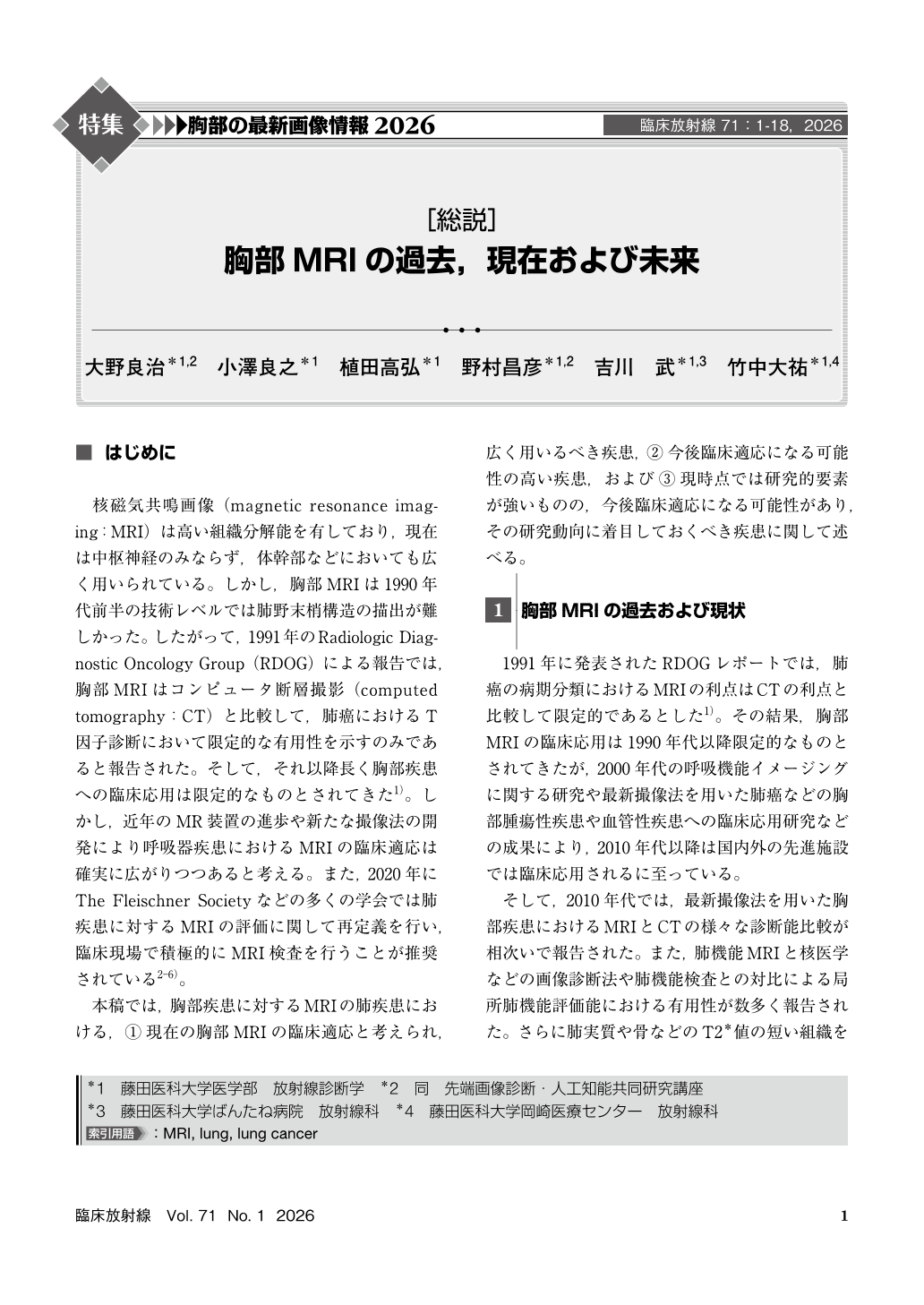
核磁気共鳴画像(magnetic resonance imaging:MRI)は高い組織分解能を有しており,現在は中枢神経のみならず,体幹部などにおいても広く用いられている。しかし,胸部MRIは1990年代前半の技術レベルでは肺野末梢構造の描出が難しかった。したがって,1991年のRadiologic Diagnostic Oncology Group(RDOG)による報告では,胸部MRIはコンピュータ断層撮影(computed tomography:CT)と比較して,肺癌におけるT因子診断において限定的な有用性を示すのみであると報告された。そして,それ以降長く胸部疾患への臨床応用は限定的なものとされてきた1)。しかし,近年のMR装置の進歩や新たな撮像法の開発により呼吸器疾患におけるMRIの臨床適応は確実に広がりつつあると考える。また,2020年にThe Fleischner Societyなどの多くの学会では肺疾患に対するMRIの評価に関して再定義を行い,臨床現場で積極的にMRI検査を行うことが推奨されている2-6)。
Since chest magnetic resonance(MR)imaging became clinically available, MR imaging has been suggested as limited indications for chest diseases. However, advancements of MR system and sequence as well as clinical application of contrast media, etc. have made it possible to increase clinical and academic potentials of MR imaging for chest diseases. This review article presents a brief history of lung MR imaging in terms of its technical aspects and major clinical indications, such as 1)what is currently available, 2)what is promising but requires further validation or evaluation and 3)which developments warrant research-based evaluations in preclinical or patient studies.
Copyright © 2026, KANEHARA SHUPPAN Co.LTD. All rights reserved.