Japanese
English
- 有料閲覧
- Abstract 文献概要
- 1ページ目 Look Inside
- 参考文献 Reference
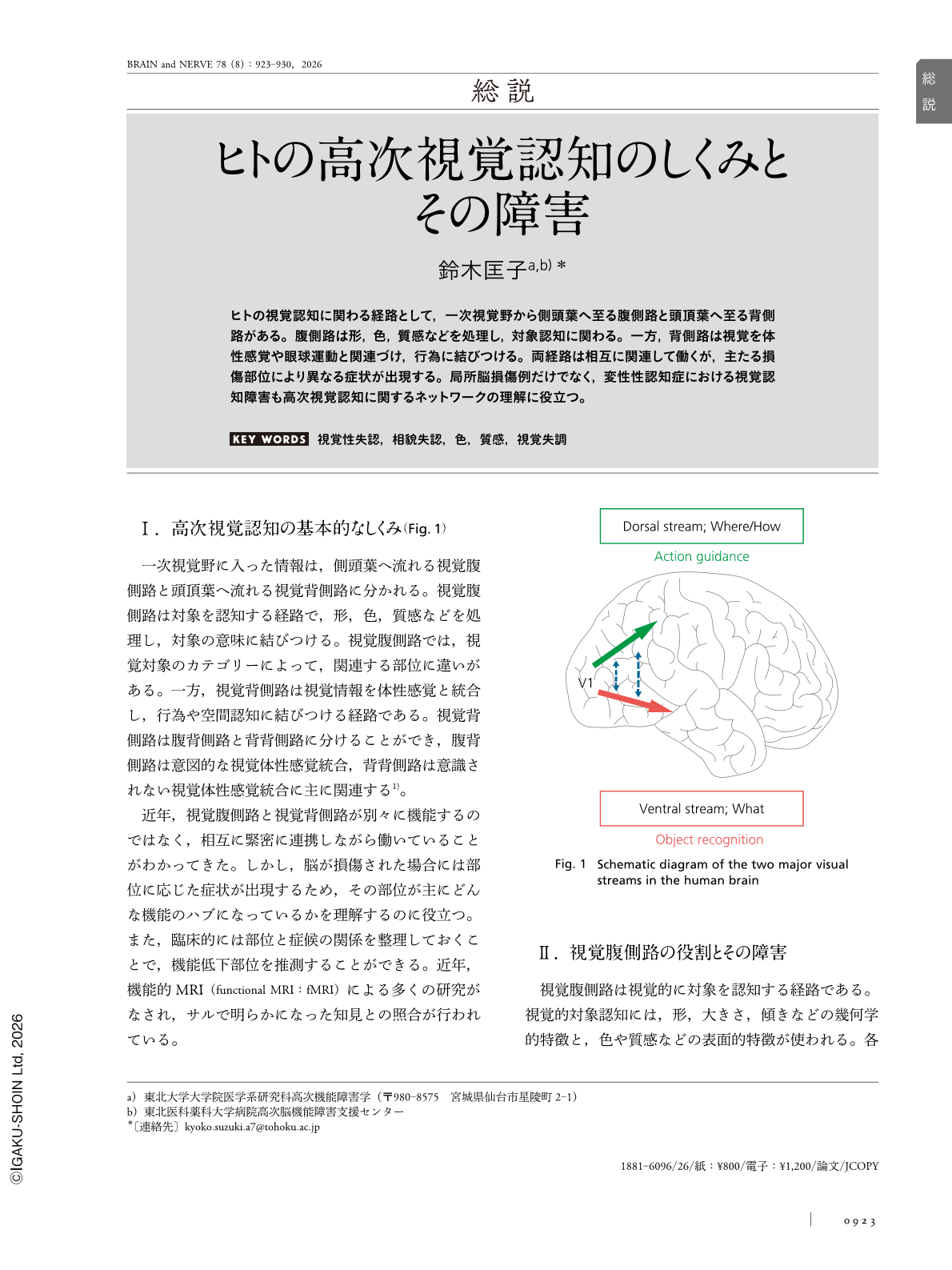
ヒトの視覚認知に関わる経路として,一次視覚野から側頭葉へ至る腹側路と頭頂葉へ至る背側路がある。腹側路は形,色,質感などを処理し,対象認知に関わる。一方,背側路は視覚を体性感覚や眼球運動と関連づけ,行為に結びつける。両経路は相互に関連して働くが,主たる損傷部位により異なる症状が出現する。局所脳損傷例だけでなく,変性性認知症における視覚認知障害も高次視覚認知に関するネットワークの理解に役立つ。
Abstract
Human visual cognition relies on two major streams that originate in the primary visual cortex: the ventral stream, which projects to the temporal lobe, and the dorsal stream, which projects to the parietal lobe. The ventral stream processes visual features such as shape, color, and texture, which are integrated to support object recognition. Within this stream, cortical regions are further organized by stimulus categories, including faces, places, words, and objects. The dorsal stream links vision with action and spatial behavior and can be subdivided into two functional substreams. The dorso-dorsal stream, centered on the superior parietal lobule, mediates online visuomotor control and reaching movements. The ventro-dorsal stream, associated with the inferior parietal lobule, contributes to object-related actions and spatial cognition. Damage to these streams produces dissociable clinical syndromes, such as visual agnosia following ventral stream damage and visual inattention after dorsal stream damage. While previous studies have mainly examined visual cognitive dysfunction due to focal lesions, neurodegenerative disorders also provide a unique opportunity to investigate visual network vulnerability. Conditions such as posterior cortical atrophy and dementia with Lewy bodies exhibit characteristic visuocognitive impairments that reflect systematic neuronal degeneration. Analyzing symptom profiles in such disorders may clarify the functional segregation of the visual streams.
Copyright © 2026, Igaku-Shoin Ltd. All rights reserved.