Japanese
English
- 有料閲覧
- Abstract 文献概要
- 1ページ目 Look Inside
- 参考文献 Reference
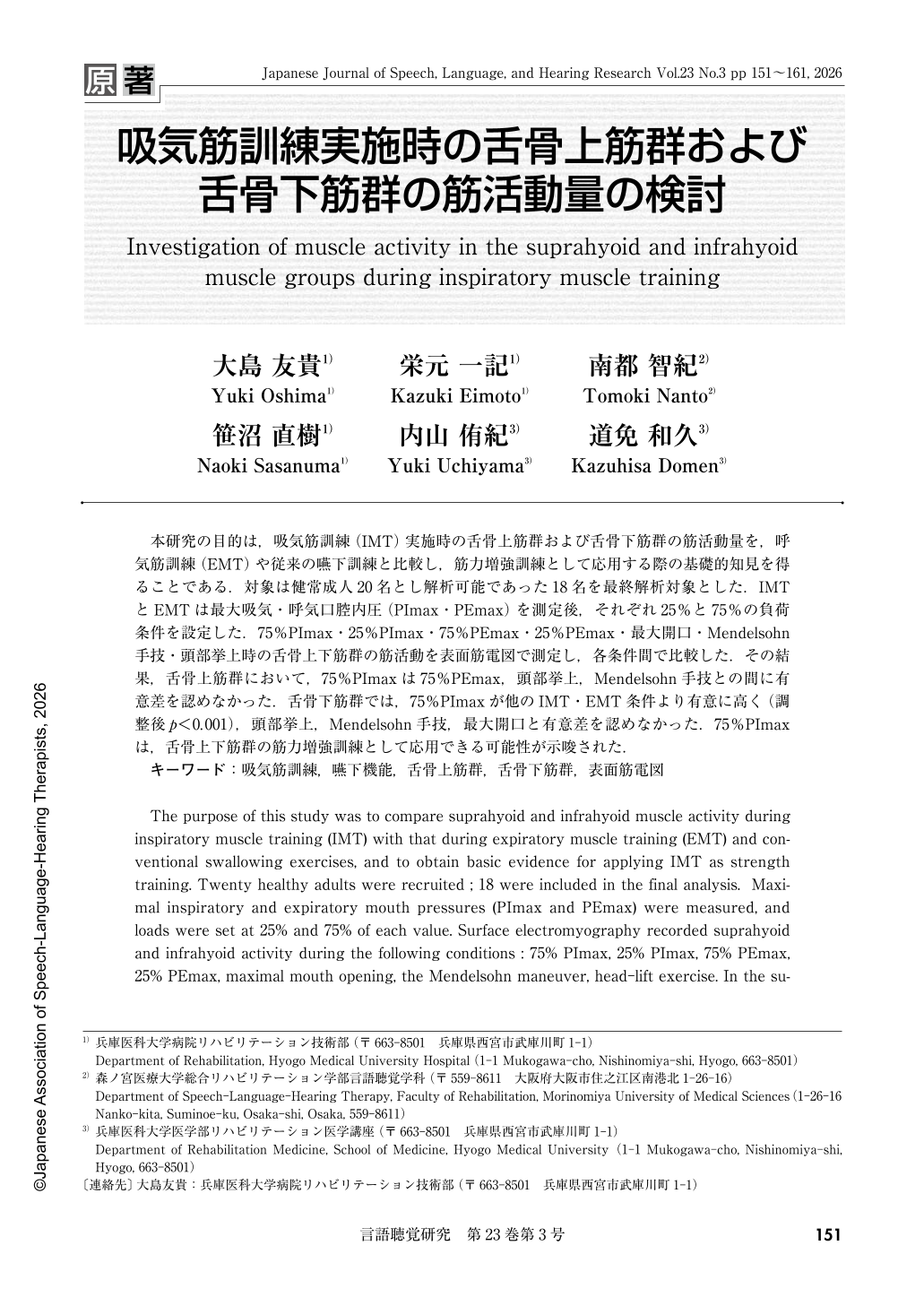
本研究の目的は,吸気筋訓練(IMT)実施時の舌骨上筋群および舌骨下筋群の筋活動量を,呼気筋訓練(EMT)や従来の嚥下訓練と比較し,筋力増強訓練として応用する際の基礎的知見を得ることである.対象は健常成人20名とし解析可能であった18名を最終解析対象とした.IMTとEMTは最大吸気・呼気口腔内圧(PImax・PEmax)を測定後,それぞれ25%と75%の負荷条件を設定した.75%PImax・25%PImax・75%PEmax・25%PEmax・最大開口・Mendelsohn手技・頭部挙上時の舌骨上下筋群の筋活動を表面筋電図で測定し,各条件間で比較した.その結果,舌骨上筋群において,75%PImaxは75%PEmax,頭部挙上,Mendelsohn手技との間に有意差を認めなかった.舌骨下筋群では,75%PImaxが他のIMT・EMT条件より有意に高く(調整後p<0.001),頭部挙上,Mendelsohn手技,最大開口と有意差を認めなかった.75%PImaxは,舌骨上下筋群の筋力増強訓練として応用できる可能性が示唆された.
The purpose of this study was to compare suprahyoid and infrahyoid muscle activity during inspiratory muscle training (IMT) with that during expiratory muscle training (EMT) and conventional swallowing exercises, and to obtain basic evidence for applying IMT as strength training. Twenty healthy adults were recruited ; 18 were included in the final analysis. Maximal inspiratory and expiratory mouth pressures (PImax and PEmax) were measured, and loads were set at 25% and 75% of each value. Surface electromyography recorded suprahyoid and infrahyoid activity during the following conditions:75% PImax, 25% PImax, 75% PEmax, 25% PEmax, maximal mouth opening, the Mendelsohn maneuver, head-lift exercise. In the suprahyoid muscles, 75% PImax showed no significant differences compared with 75% PEmax, head-lift, or the Mendelsohn maneuver. In the infrahyoid muscles, 75% PImax was significantly higher than other IMT or EMT conditions (adjusted p < 0.001) and did not differ from head-lift, the Mendelsohn maneuver, or maximal mouth opening. These results suggest that IMT at 75% PImax may be applicable for strengthening both muscle groups.
Copyright © 2026, Japanese Association of Speech-Language-Hearing Therapists. All rights reserved.