Japanese
English
- 有料閲覧
- Abstract 文献概要
- 1ページ目 Look Inside
- 参考文献 Reference
Point
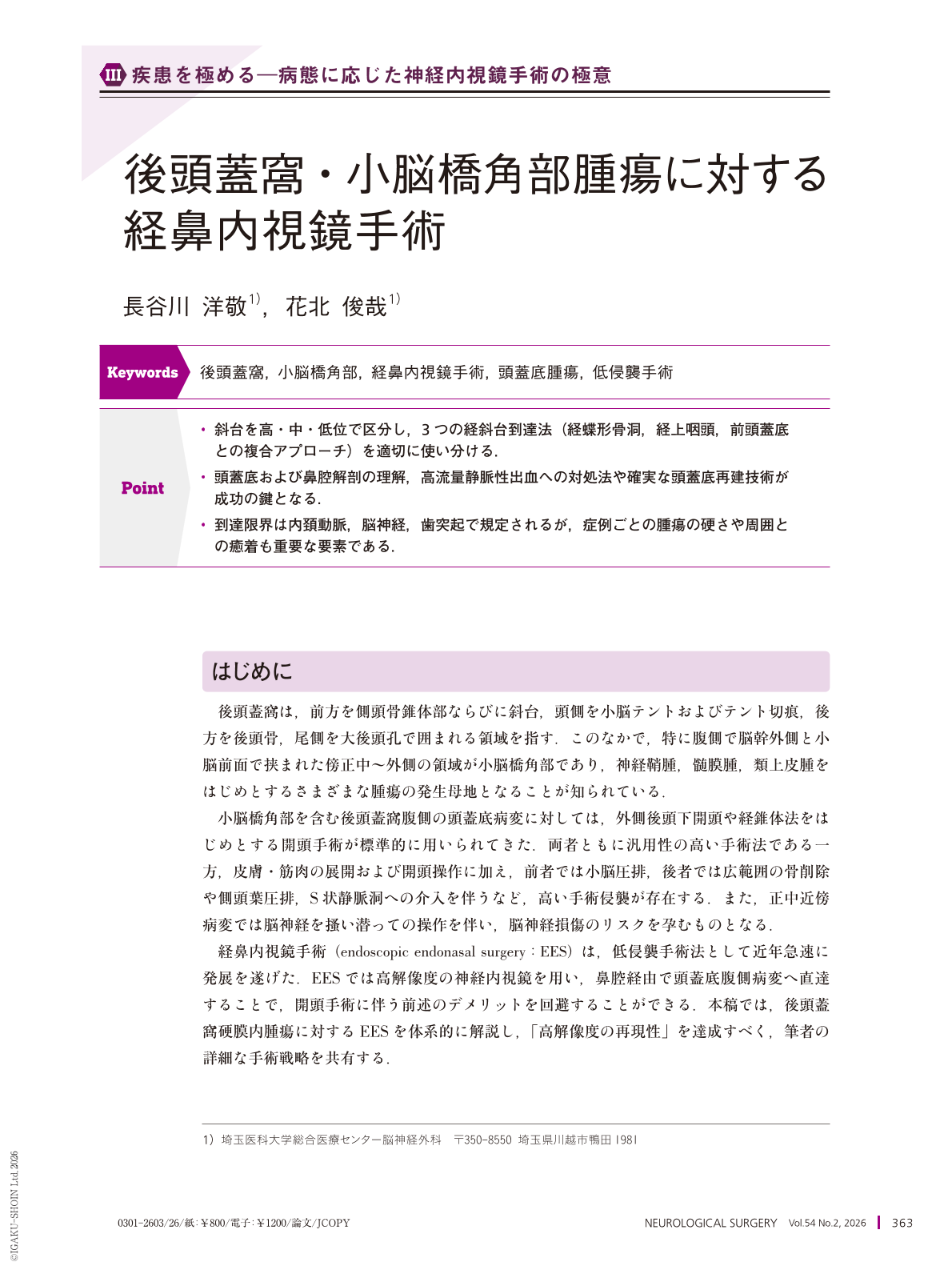
・斜台を高・中・低位で区分し,3つの経斜台到達法(経蝶形骨洞,経上咽頭,前頭蓋底との複合アプローチ)を適切に使い分ける.
・頭蓋底および鼻腔解剖の理解,高流量静脈性出血への対処法や確実な頭蓋底再建技術が成功の鍵となる.
・到達限界は内頚動脈,脳神経,歯突起で規定されるが,症例ごとの腫瘍の硬さや周囲との癒着も重要な要素である.
*本論文中、[Video]マークのある図につきましては、関連する動画を見ることができます(公開期間:2029年4月まで)。
Endoscopic endonasal surgery (EES) has rapidly evolved as a minimally invasive option for ventral posterior fossa lesions, offering a direct midline corridor while avoiding soft-tissue dissection, cerebellar or temporal lobe retraction, and the extensive petrosectomy required in traditional open approaches. However, the indications, anatomical concepts, and technical nuances for safely applying EES to intradural posterior fossa tumors have not yet been standardized. This article presents a practical, stepwise overview of EES for posterior fossa intradural tumors arising around the clivus and ventral brainstem. Based on a three-level clival classification (high, middle, and low clivus defined by Dorello's canal and glossopharyngeal meatus), we outlined the rational selection and execution of transsphenoidal transclival, transpharyngeal transclival, and combined approaches with pituitary transposition. Detailed descriptions of the nasal and skull base exposure, management of high-flow venous and CSF bleeding, and multilayer reconstruction using fascia, rigid buttress, fat graft, and a robust rhinopharyngeal flap. By sharing a reproducible high-resolution strategy grounded in anatomical principles and reconstructive techniques, we aimed to facilitate the safe expansion of EES indications for complex posterior fossa tumors.
Copyright © 2026, Igaku-Shoin Ltd. All rights reserved.