Japanese
English
- 有料閲覧
- Abstract 文献概要
- 1ページ目 Look Inside
- 参考文献 Reference
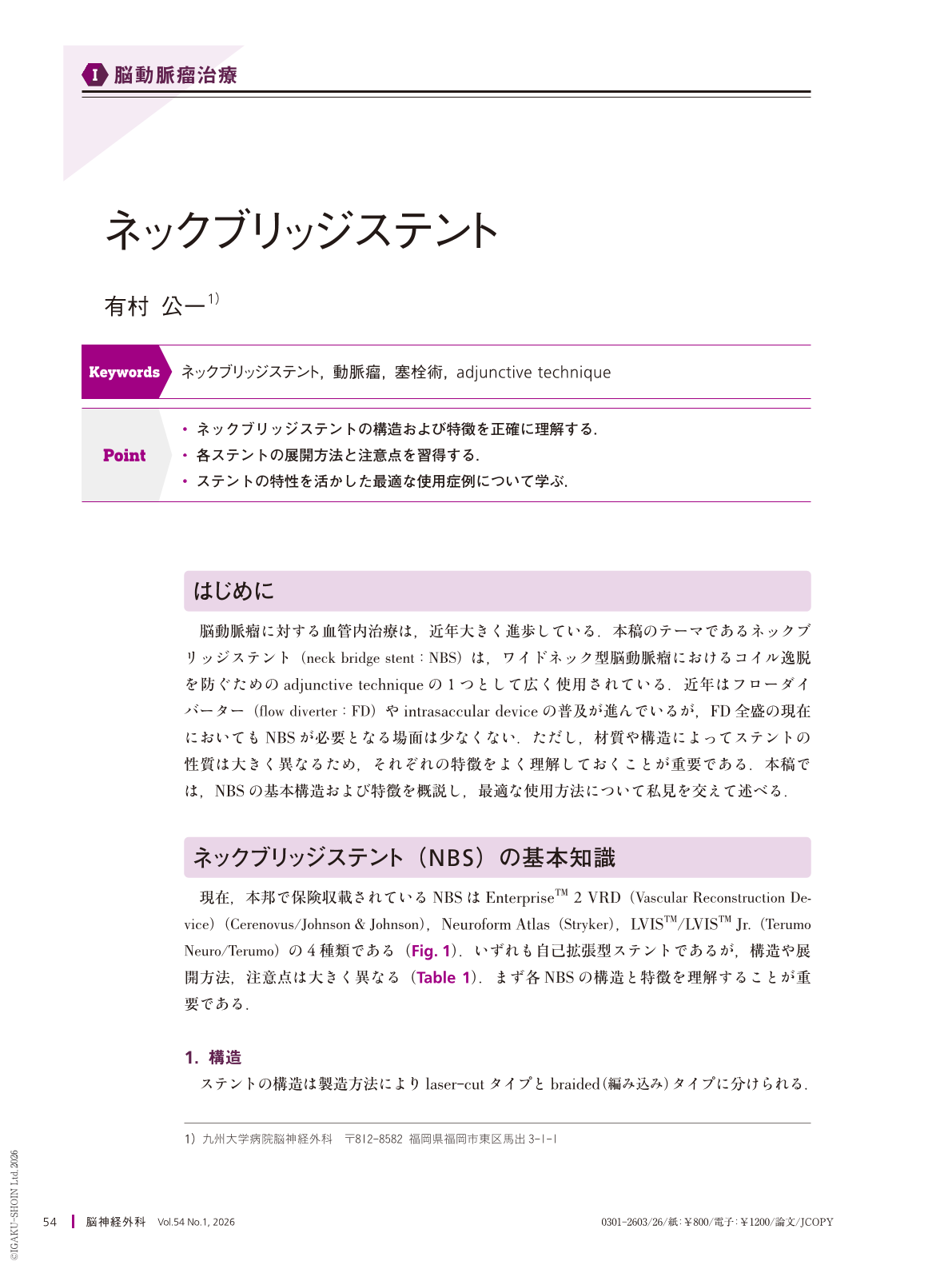
Point
・ネックブリッジステントの構造および特徴を正確に理解する.
・各ステントの展開方法と注意点を習得する.
・ステントの特性を活かした最適な使用症例について学ぶ.
Neck-bridge stents (NBS) play an essential role in the endovascular treatment of wide-neck intracranial aneurysms despite the increasing use of flow diverters and intrasaccular devices. Currently available NBS in Japan include the Enterprise VRD 2, LVIS/LVIS Jr, and Neuroform Atlas, each with distinct structural characteristics that influence deployment techniques and clinical applications. Laser-cut stents offer easier deployment and the ability to be resheathed, whereas braided stents provide higher mesh density and enhanced flow modification. Open-cell and closed-cell designs further determine vessel wall apposition and navigability in tortuous anatomies. Stent-assisted coiling can be performed using jailing or trans-cell techniques, each requiring careful microcatheter control to prevent coil protrusion or catheter kickback. Understanding the mechanical properties of each device allows clinicians to select the most appropriate stent based on aneurysm morphology, vessel tortuosity, and the need for flow modification or branch preservation. The enterprise VRD 2 is advantageous for straightening effects and ease of placement, LVIS is suitable for high-flow modification and tight neck coverage, and the Neuroform Atlas offers excellent conformability in bifurcation or highly curved vessels. This review summarizes the fundamental characteristics of NBS and provides practical insights for their optimal application in contemporary aneurysm treatment.
Copyright © 2026, Igaku-Shoin Ltd. All rights reserved.