Japanese
English
- 有料閲覧
PPV購入案内
1,320円 (1,200円+税10%) こちらは、351ページから357ページの文献です。購入には医書.jp本会員登録が必要です。
会員登録完了後に改めて上記「購入サイトへ」を選択してください。
または「購入サイトへ」選択後に「購入ログイン」、「新規会員登録」の順に進んでください。
会員登録について詳しくはをご確認ください。
- Abstract 文献概要
- 1ページ目 Look Inside
- 参考文献 Reference
はじめに
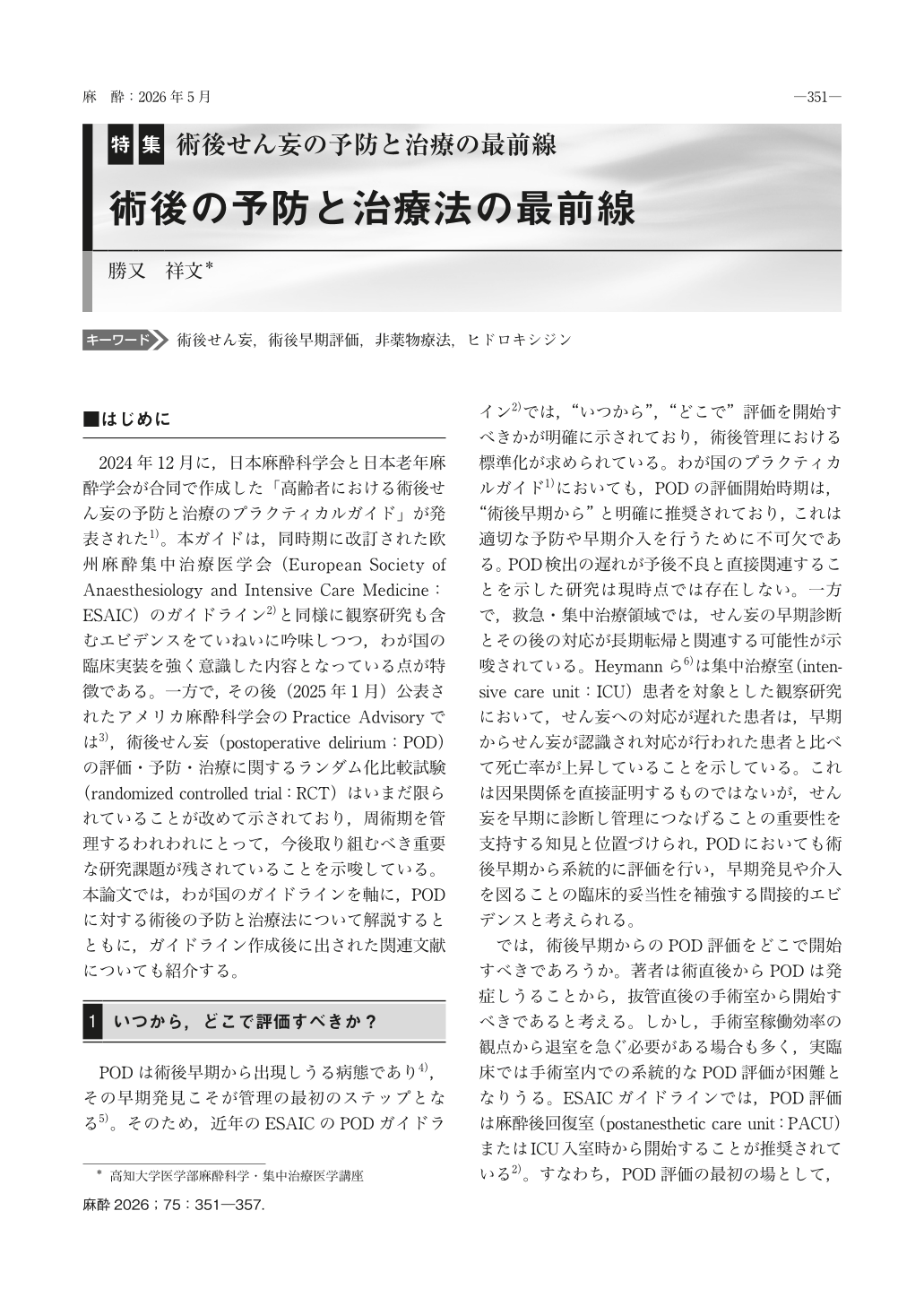
2024年12月に,日本麻酔科学会と日本老年麻酔学会が合同で作成した「高齢者における術後せん妄の予防と治療のプラクティカルガイド」が発表された1)。本ガイドは,同時期に改訂された欧州麻酔集中治療医学会(European Society of Anaesthesiology and Intensive Care Medicine:ESAIC)のガイドライン2)と同様に観察研究も含むエビデンスをていねいに吟味しつつ,わが国の臨床実装を強く意識した内容となっている点が特徴である。一方で,その後(2025年1月)公表されたアメリカ麻酔科学会のPractice Advisoryでは3),術後せん妄(postoperative delirium:POD)の評価・予防・治療に関するランダム化比較試験(randomized controlled trial:RCT)はいまだ限られていることが改めて示されており,周術期を管理するわれわれにとって,今後取り組むべき重要な研究課題が残されていることを示唆している。本論文では,わが国のガイドラインを軸に,PODに対する術後の予防と治療法について解説するとともに,ガイドライン作成後に出された関連文献についても紹介する。
Postoperative delirium(POD)can emerge early after surgery and is associated with adverse outcomes, and its timely recognition and structured postoperative management are thus essential. In December 2024, the Japanese Society of Anesthesiologists and the Japanese Society of Geriatric Anesthesiology(JSA/JSGA)jointly released a practical guideline for the prevention and treatment of POD in older adults, emphasizing the feasibility of the prevention and treatment in real-world clinical settings. Consistent with the updated European Society of Anaesthesiology and Intensive Care(ESAIC)guideline, the JSA/JSGA guideline recommends early and repeated POD assessments using validated screening tools, ideally beginning in the postanesthesia care unit(PACU)or upon ICU admission, although the limited PACU availability in Japan often shifts the initial evaluation of patients’ potential POD to the ward. Prevention should prioritize high-quality perioperative care rather than a reliance on specific drugs, including adequate analgesia with multimodal strategies, sleep and environmental optimization, the maintenance of circadian rhythms, early mobilization, and the use of sensory aids. Pharmacologic prophylaxis, including dexmedetomidine, should be used cautiously given the hemodynamic adverse effects and uncertain net benefit. The treatment of established POD centers on identifying and correcting the underlying cause(s)and precipitating factor(s);routine pharmacologic therapy is not supported, and symptom-directed medication should be reserved for severe agitation with a risk of harm. Emerging data obtained in Japan suggest that intravenous hydroxyzine may be a potential alternative to antipsychotics for the treatment of POD, warranting further investigation.
Copyright © 2026 KOKUSEIDO CO., LTD. All Rights Reserved.