Japanese
English
- 有料閲覧
PPV購入案内
1,650円 (1,500円+税10%) こちらは、792ページから798ページの文献です。購入には医書.jp本会員登録が必要です。
会員登録完了後に改めて上記「購入サイトへ」を選択してください。
または「購入サイトへ」選択後に「購入ログイン」、「新規会員登録」の順に進んでください。
会員登録について詳しくはをご確認ください。
- Abstract 文献概要
- 1ページ目 Look Inside
- 参考文献 Reference
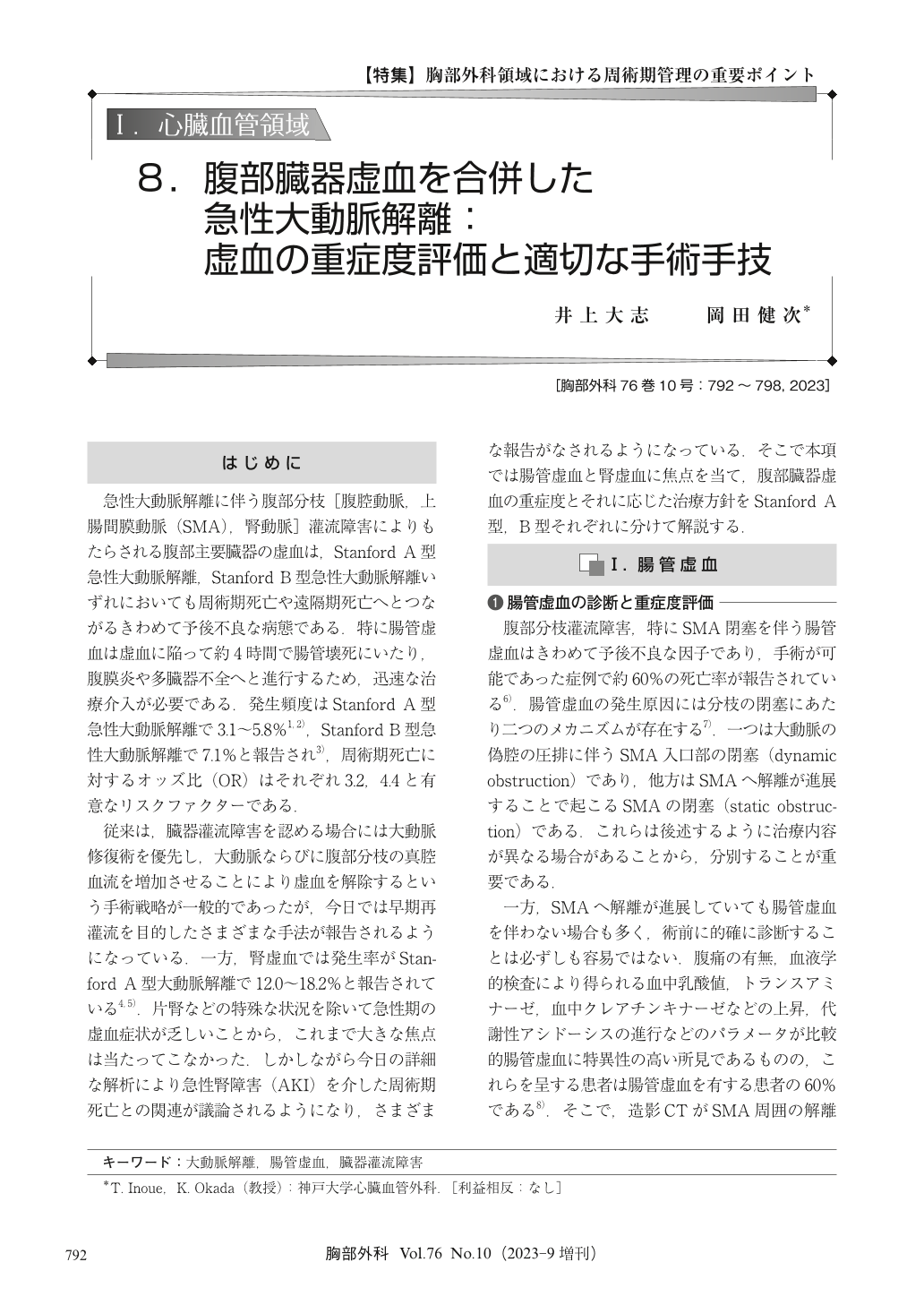
急性大動脈解離に伴う腹部分枝[腹腔動脈,上腸間膜動脈(SMA),腎動脈]灌流障害によりもたらされる腹部主要臓器の虚血は,Stanford A型急性大動脈解離,Stanford B型急性大動脈解離いずれにおいても周術期死亡や遠隔期死亡へとつながるきわめて予後不良な病態である.特に腸管虚血は虚血に陥って約4時間で腸管壊死にいたり,腹膜炎や多臓器不全へと進行するため,迅速な治療介入が必要である.発生頻度はStanford A型急性大動脈解離で3.1~5.8%1,2),Stanford B型急性大動脈解離で7.1%と報告され3),周術期死亡に対するオッズ比(OR)はそれぞれ3.2,4.4と有意なリスクファクターである.
Malperfusion syndrome of the visceral branches associated with acute aortic dissection brings an extremely poor outcomes leading to perioperative and long-term mortality in both Stanford type A and type B acute aortic dissection. The conventional surgical strategy for these cases has been to prioritize aortic repair and to improve blood flow of true lumen in aorta and visceral branches. Today, various techniques for early reperfusion have been reported. For bowel ischemia, it is necessary to evaluate substantial ischemia of the intestinal tract and hypoperfusion of the superior mesenteric artery (SMA) using contrast-enhanced computed tomography (CT) and intraoperative transesophageal echocardiography in addition to clinical presentation. The most important factor of the surgical intervention is the improvement of true luminal blood flow by reconstruction of the central aorta. However, an intervention to SMA prior to central aortic repair might be an important process for patients with Stanford type A acute aortic dissection to avoid irreversible bowel necrosis. In type B aortic dissection, thoracic endovascular aortic repair (TEVAR) with or without provisional extension to induce complete attachment (PETTICOAT) technique and additional SMA intervention based on intraoperative contrast findings are necessary. Renal malperfusion is also a risk factor of postoperative accute kidney injury (AKI) and perioperative mortality. The revascularizations of renal arteries might improve outcomes when renal blood flow was not recovered with central aortic repair.
© Nankodo Co., Ltd., 2023