Japanese
English
- 有料閲覧
PPV購入案内
1,320円 (1,200円+税10%) こちらは、522ページから530ページの文献です。購入には医書.jp本会員登録が必要です。
会員登録完了後に改めて上記「購入サイトへ」を選択してください。
または「購入サイトへ」選択後に「購入ログイン」、「新規会員登録」の順に進んでください。
会員登録について詳しくはをご確認ください。
- Abstract 文献概要
- 1ページ目 Look Inside
- 参考文献 Reference
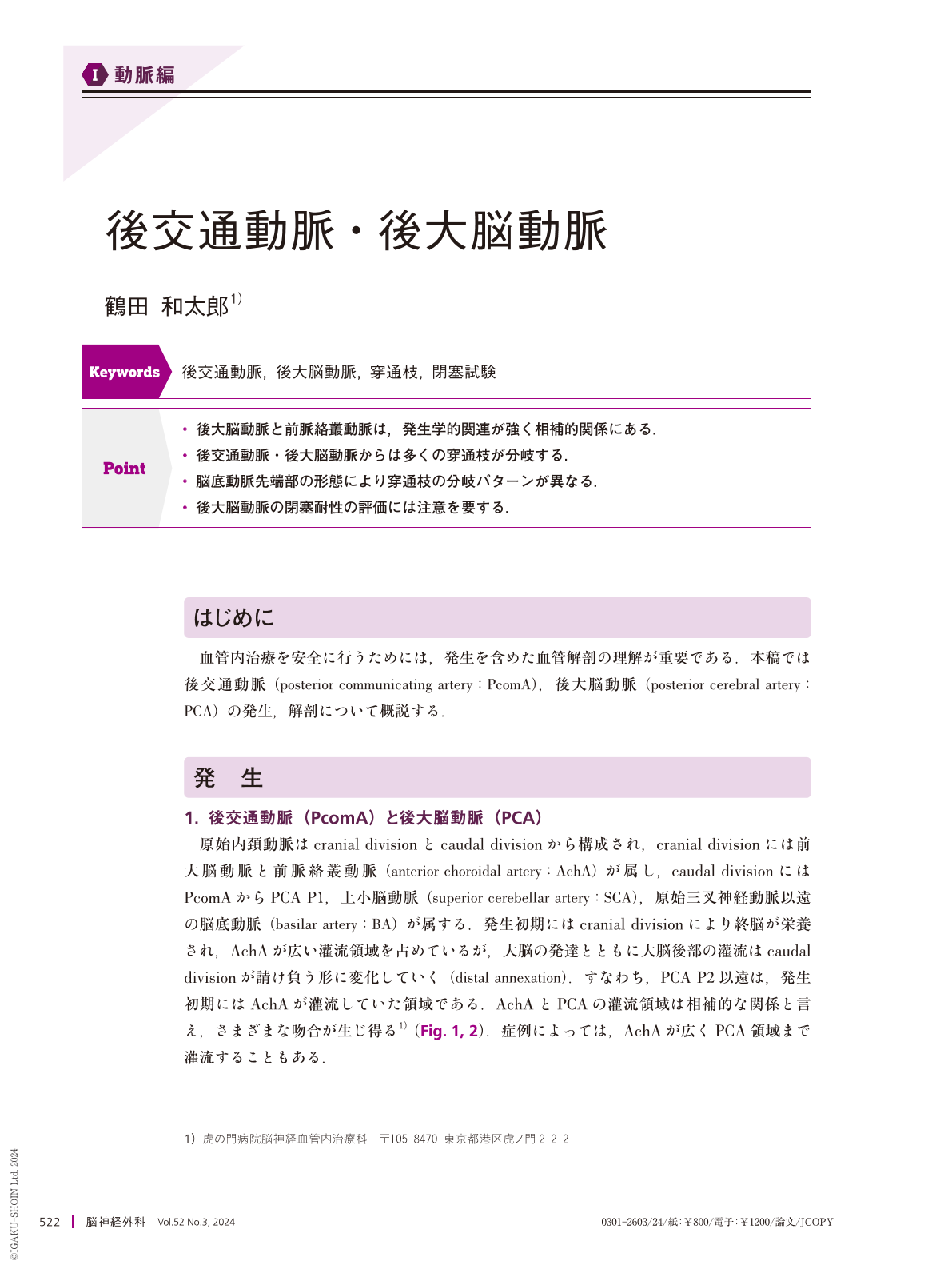
Point
・後大脳動脈と前脈絡叢動脈は,発生学的関連が強く相補的関係にある.
・後交通動脈・後大脳動脈からは多くの穿通枝が分岐する.
・脳底動脈先端部の形態により穿通枝の分岐パターンが異なる.
・後大脳動脈の閉塞耐性の評価には注意を要する.
Thorough understanding of the vascular anatomy, including embryological development of vessels is important to safely perform endovascular procedures. The posterior cerebral and anterior choroidal arteries are embryologically complementary, which suggests a potential network. Numerous perforators originate from the posterior communicating and posterior cerebral arteries. The tuberothalamic artery arising from the posterior communicating artery and the thalamoperforating artery, which originates from the P1 segment of the posterior cerebral artery are clinically important because occlusion of these vessels can precipitate severe infarction. It is clinically important to be aware that the branching pattern of perforators differs based on the fusion type of the basilar tip. The balloon occlusion and Allcock test are useful to predict ischemic tolerance in cases of intentional artery occlusion. However, accurate prediction remains challenging, and a definitive evaluation method is unavailable. Flow disturbances in the cortical territory and local perforator impairment require close attention in cases of intentional artery occlusion.
Copyright © 2024, Igaku-Shoin Ltd. All rights reserved.