Japanese
English
- 有料閲覧
PPV購入案内
1,320円 (1,200円+税10%) こちらは、395ページから400ページの文献です。購入には医書.jp本会員登録が必要です。
会員登録完了後に改めて上記「購入サイトへ」を選択してください。
または「購入サイトへ」選択後に「購入ログイン」、「新規会員登録」の順に進んでください。
会員登録について詳しくはをご確認ください。
- Abstract 文献概要
- 1ページ目 Look Inside
- 参考文献 Reference
はじめに
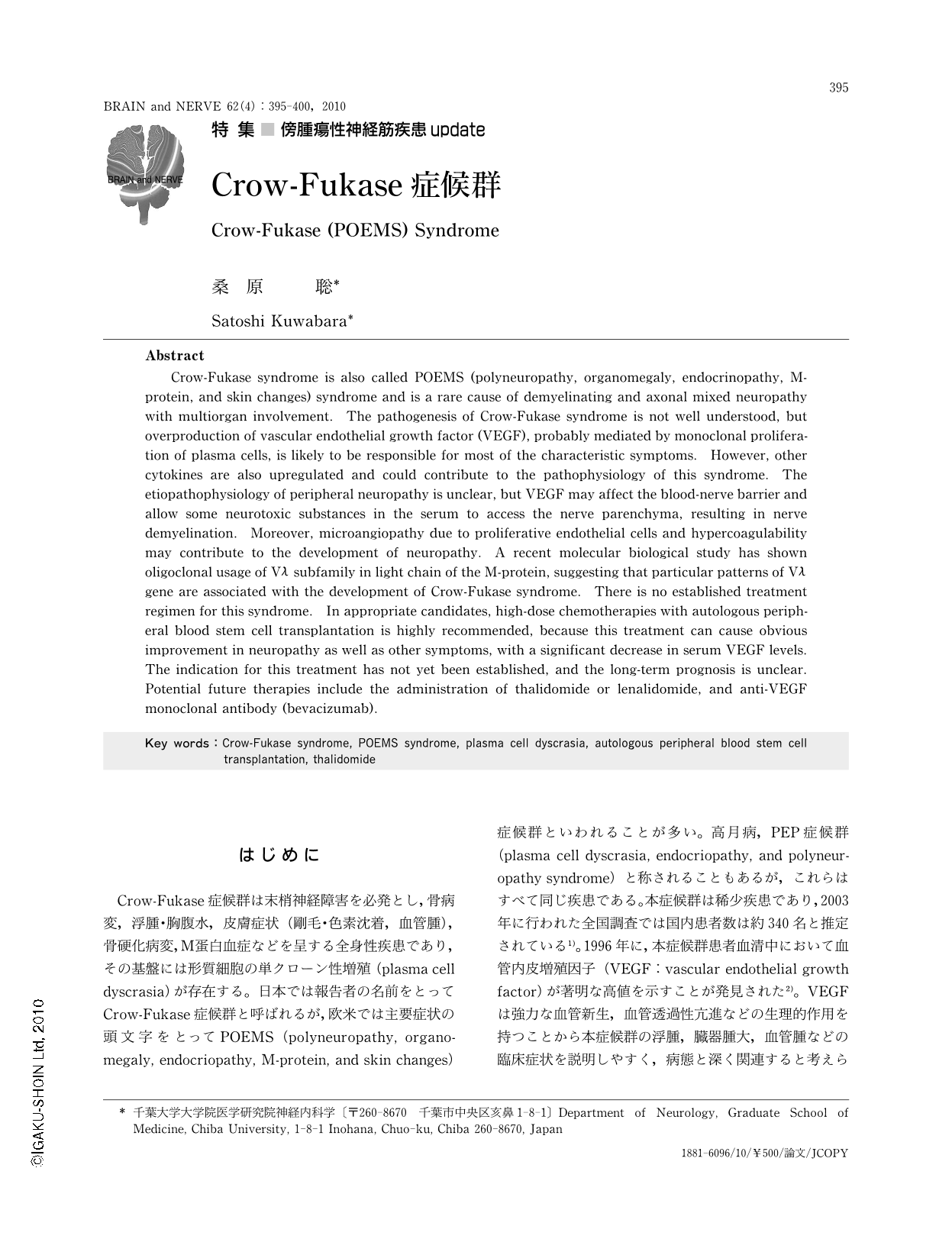
Crow-Fukase症候群は末梢神経障害を必発とし,骨病変,浮腫・胸腹水,皮膚症状(剛毛・色素沈着,血管腫),骨硬化病変,M蛋白血症などを呈する全身性疾患であり,その基盤には形質細胞の単クローン性増殖(plasma cell dyscrasia)が存在する。日本では報告者の名前をとってCrow-Fukase症候群と呼ばれるが,欧米では主要症状の頭文字をとってPOEMS(polyneuropathy, organomegaly, endocriopathy, M-protein, and skin changes)症候群といわれることが多い。高月病,PEP症候群(plasma cell dyscrasia, endocriopathy, and polyneuropathy syndrome)と称されることもあるが,これらはすべて同じ疾患である。本症候群は稀少疾患であり,2003年に行われた全国調査では国内患者数は約340名と推定されている1)。1996年に,本症候群患者血清中において血管内皮増殖因子(VEGF:vascular endothelial growth factor)が著明な高値を示すことが発見された2)。VEGFは強力な血管新生,血管透過性亢進などの生理的作用を持つことから本症候群の浮腫,臓器腫大,血管腫などの臨床症状を説明しやすく,病態と深く関連すると考えられており3-5),現在VEGFを含めた診断基準が提唱されている(Table1)6,7)。
一般に傍腫瘍性神経症候群は,腫瘍と神経系の共通抗原により惹起される免疫介在性の神経・筋症状を呈する病態と定義される。Crow-Fukase症候群は形質細胞の単クローン性増殖は存在するものの,その病態はVEGFを中心とするサイトカインの過剰産生に基づいており,狭義の傍腫瘍性神経症候群とは異なった特殊な病態を有しているといえる。
Abstract
Crow-Fukase syndrome is also called POEMS (polyneuropathy,organomegaly,endocrinopathy,M-protein,and skin changes) syndrome and is a rare cause of demyelinating and axonal mixed neuropathy with multiorgan involvement. The pathogenesis of Crow-Fukase syndrome is not well understood,but overproduction of vascular endothelial growth factor (VEGF),probably mediated by monoclonal proliferation of plasma cells,is likely to be responsible for most of the characteristic symptoms. However,other cytokines are also upregulated and could contribute to the pathophysiology of this syndrome. The etiopathophysiology of peripheral neuropathy is unclear,but VEGF may affect the blood-nerve barrier and allow some neurotoxic substances in the serum to access the nerve parenchyma,resulting in nerve demyelination. Moreover,microangiopathy due to proliferative endothelial cells and hypercoagulability may contribute to the development of neuropathy. A recent molecular biological study has shown oligoclonal usage of Vλ subfamily in light chain of the M-protein,suggesting that particular patterns of Vλ gene are associated with the development of Crow-Fukase syndrome. There is no established treatment regimen for this syndrome. In appropriate candidates,high-dose chemotherapies with autologous peripheral blood stem cell transplantation is highly recommended,because this treatment can cause obvious improvement in neuropathy as well as other symptoms,with a significant decrease in serum VEGF levels. The indication for this treatment has not yet been established,and the long-term prognosis is unclear. Potential future therapies include the administration of thalidomide or lenalidomide,and anti-VEGF monoclonal antibody (bevacizumab).
Copyright © 2010, Igaku-Shoin Ltd. All rights reserved.