Japanese
English
- 有料閲覧
PPV購入案内
1,320円 (1,200円+税10%) こちらは、1059ページから1063ページの文献です。購入には医書.jp本会員登録が必要です。
会員登録完了後に改めて上記「購入サイトへ」を選択してください。
または「購入サイトへ」選択後に「購入ログイン」、「新規会員登録」の順に進んでください。
会員登録について詳しくはをご確認ください。
- Abstract 文献概要
- 1ページ目 Look Inside
- 参考文献 Reference
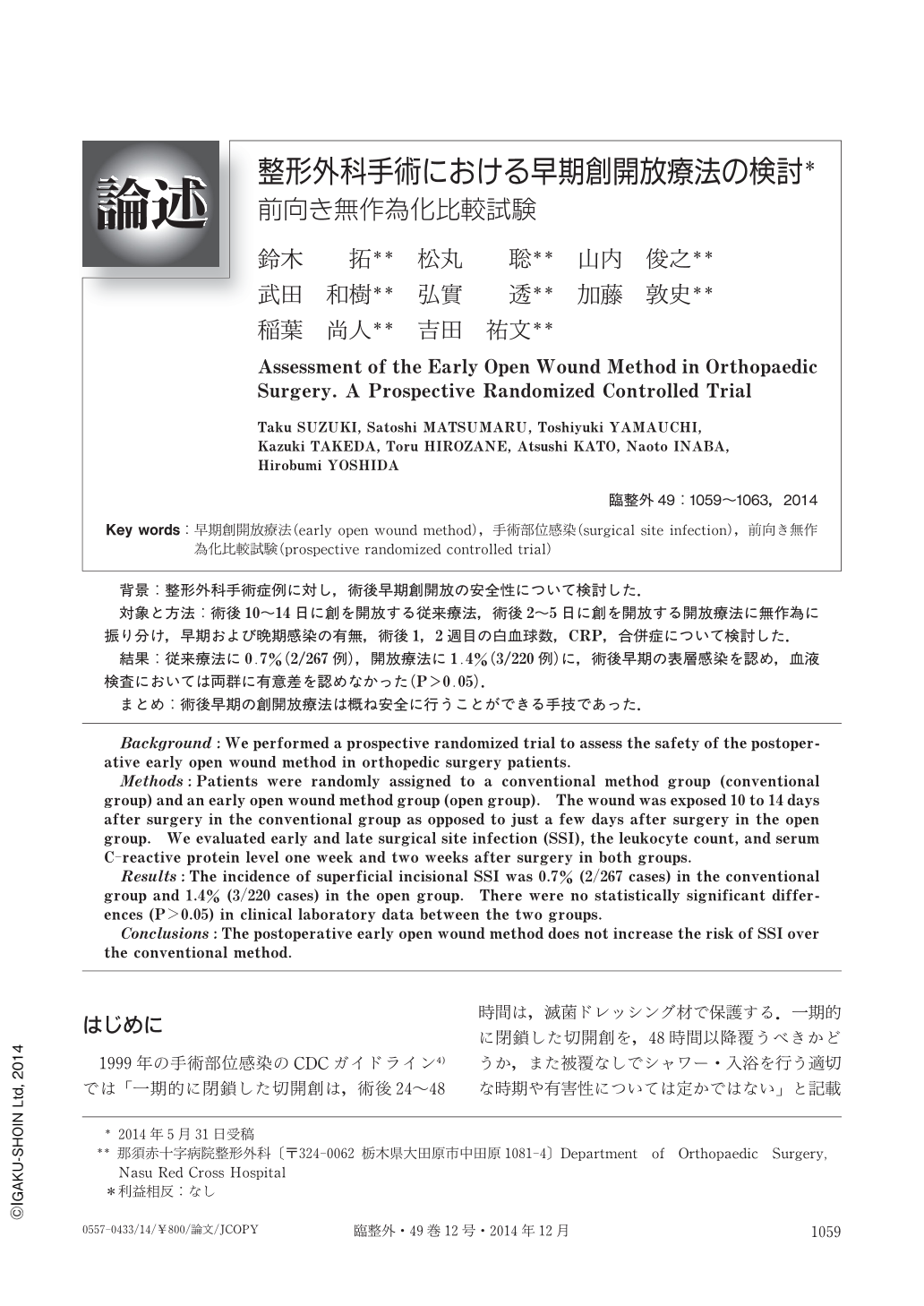
背景:整形外科手術症例に対し,術後早期創開放の安全性について検討した.
対象と方法:術後10〜14日に創を開放する従来療法,術後2〜5日に創を開放する開放療法に無作為に振り分け,早期および晩期感染の有無,術後1,2週目の白血球数,CRP,合併症について検討した.
結果:従来療法に0.7%(2/267例),開放療法に1.4%(3/220例)に,術後早期の表層感染を認め,血液検査においては両群に有意差を認めなかった(P>0.05).
まとめ:術後早期の創開放療法は概ね安全に行うことができる手技であった.
Background:We performed a prospective randomized trial to assess the safety of the postoperative early open wound method in orthopedic surgery patients.
Methods:Patients were randomly assigned to a conventional method group (conventional group) and an early open wound method group (open group). The wound was exposed 10 to 14 days after surgery in the conventional group as opposed to just a few days after surgery in the open group. We evaluated early and late surgical site infection (SSI), the leukocyte count, and serum C-reactive protein level one week and two weeks after surgery in both groups.
Results:The incidence of superficial incisional SSI was 0.7% (2/267 cases) in the conventional group and 1.4% (3/220 cases) in the open group. There were no statistically significant differences (P>0.05) in clinical laboratory data between the two groups.
Conclusions:The postoperative early open wound method does not increase the risk of SSI over the conventional method.
Copyright © 2014, Igaku-Shoin Ltd. All rights reserved.