Japanese
English
- 有料閲覧
PPV購入案内
1,320円 (1,200円+税10%) こちらは、249ページから256ページの文献です。購入には医書.jp本会員登録が必要です。
会員登録完了後に改めて上記「購入サイトへ」を選択してください。
または「購入サイトへ」選択後に「購入ログイン」、「新規会員登録」の順に進んでください。
会員登録について詳しくはをご確認ください。
- Abstract 文献概要
- 1ページ目 Look Inside
- 参考文献 Reference
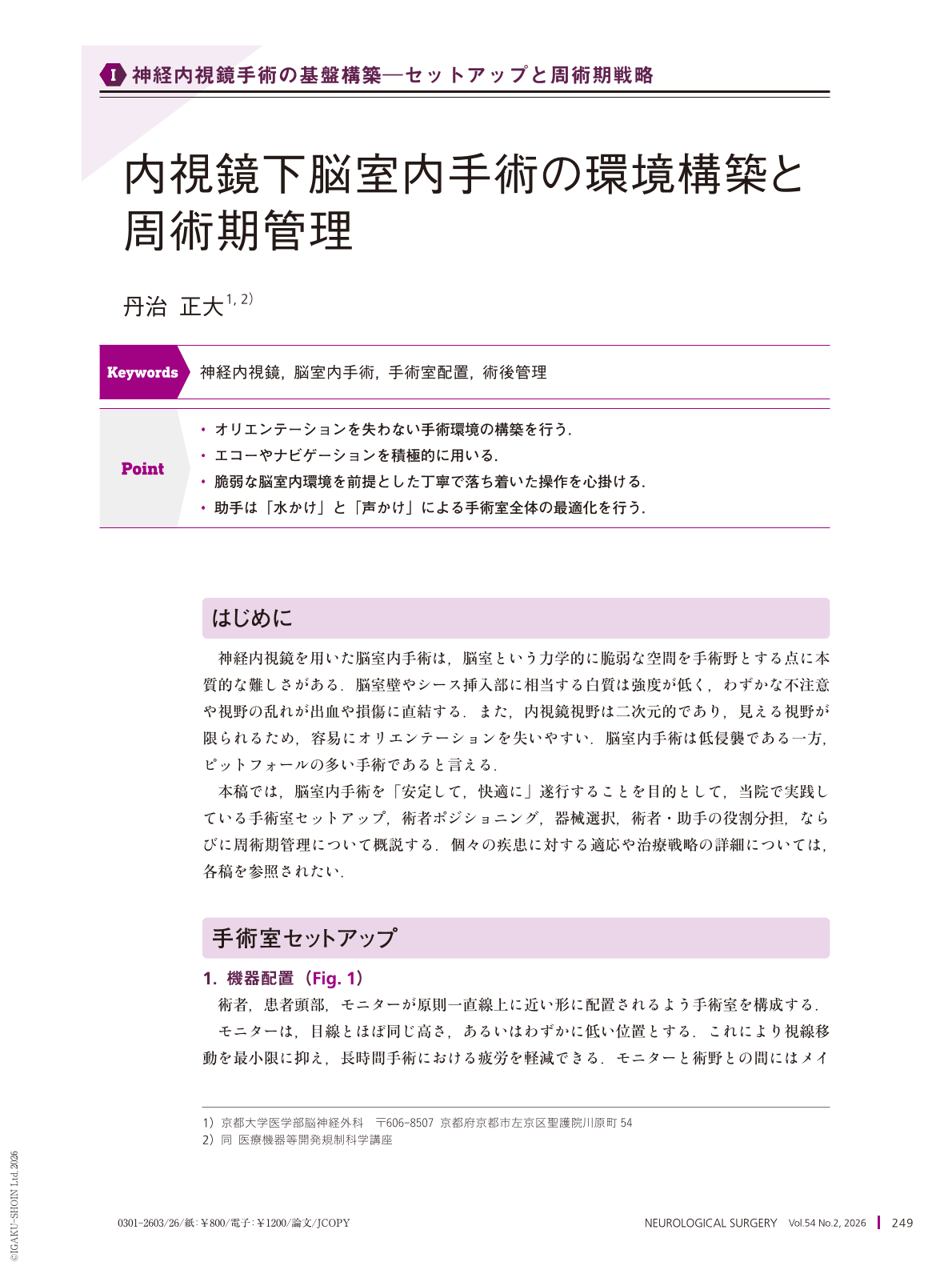
Point
・オリエンテーションを失わない手術環境の構築を行う.
・エコーやナビゲーションを積極的に用いる.
・脆弱な脳室内環境を前提とした丁寧で落ち着いた操作を心掛ける.
・助手は「水かけ」と「声かけ」による手術室全体の最適化を行う.
Neuroendoscopic intraventricular surgery provides a minimally invasive approach but is inherently challenging, as it is performed within a fragile, three-dimensional ventricular space while relying on a limited two-dimensional endoscopic view. Loss of orientation and subtle technical errors can result in hemorrhage or neural injury. This chapter describes practical strategies for achieving stable and reproducible neuroendoscopic intraventricular surgery, with emphasis on operating room setup, instrumentation, teamwork, and perioperative management.
Key principles include aligning the surgeon, patient, and monitor to maintain visuomotor consistency; proactive use of navigation and intraoperative ultrasound to prevent misplacement; and gentle, deliberate manipulation of the vulnerability of ventricular structures. Instrument selection, including rigid scopes, channel-based rigid endoscopic systems, and coagulation-suction devices, is discussed from a safety-oriented perspective.
A central emphasis is placed on the role of the assistant, whose responsibilities extend beyond irrigation control ( “water management” ) to include verbal cues and optimization of the surgical environment. Perioperative management, particularly external ventricular drainage (EVD) strategies, postoperative fever, and the role of neuroendoscopic ventricular irrigation in ventriculitis, are also reviewed. Collectively, these concepts highlight that successful neuroendoscopic surgery depends not only on technical proficiency but also on comprehensive surgical design and effective team coordination.
Copyright © 2026, Igaku-Shoin Ltd. All rights reserved.