Japanese
English
- 有料閲覧
- Abstract 文献概要
- 1ページ目 Look Inside
- 参考文献 Reference
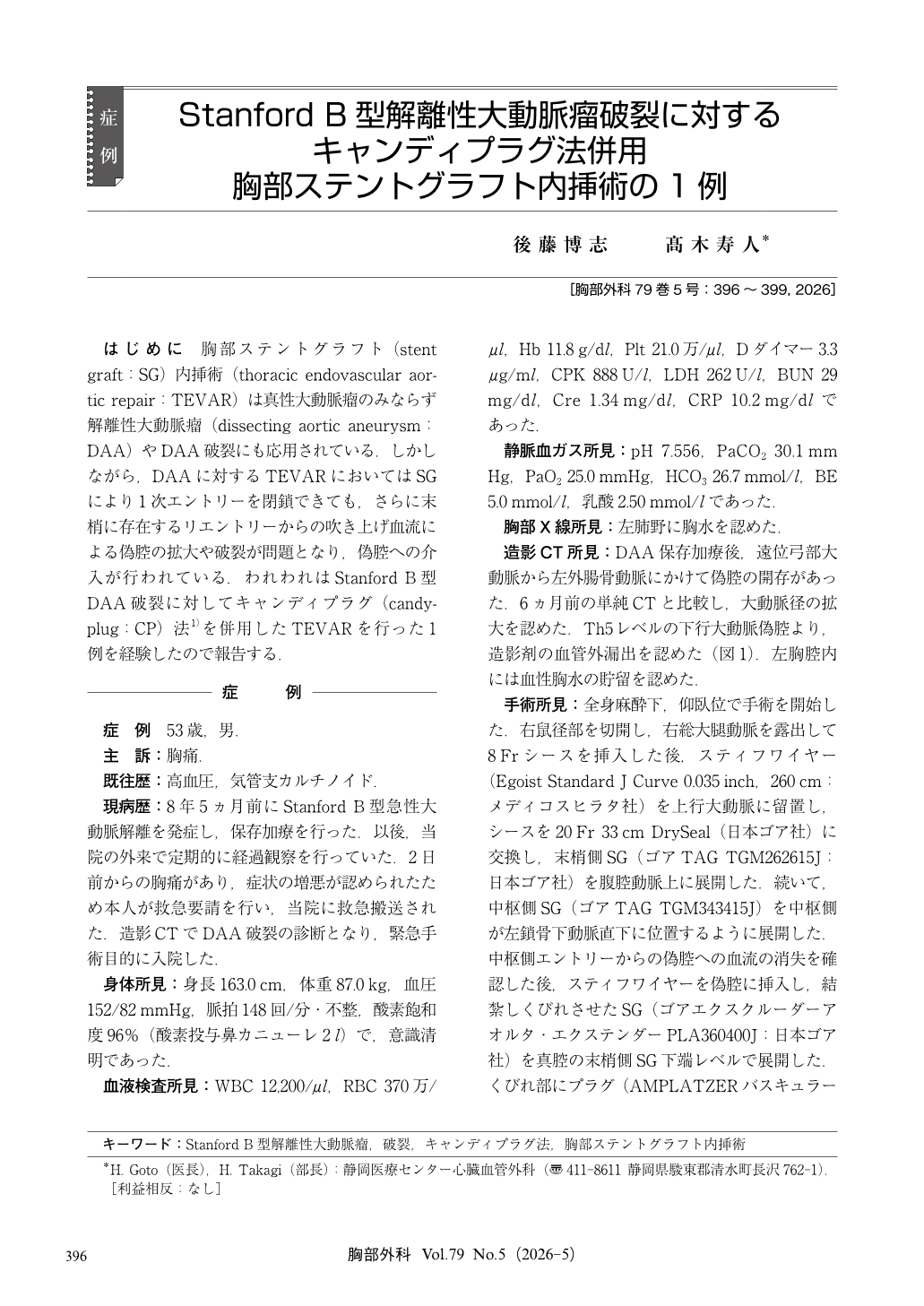
はじめに 胸部ステントグラフト(stent graft:SG)内挿術(thoracic endovascular aortic repair:TEVAR)は真性大動脈瘤のみならず解離性大動脈瘤(dissecting aortic aneurysm:DAA)やDAA破裂にも応用されている.しかしながら,DAAに対するTEVARにおいてはSGにより1次エントリーを閉鎖できても,さらに末梢に存在するリエントリーからの吹き上げ血流による偽腔の拡大や破裂が問題となり,偽腔への介入が行われている.われわれはStanford B型DAA破裂に対してキャンディプラグ(candy-plug:CP)法1)を併用したTEVARを行った1例を経験したので報告する.
Thoracic endovascular aortic repair (TEVAR) has been widely applied to not only true aortic aneurysms but also dissecting aortic aneurysms (DAA). However, persistent false lumen perfusion from distal re-entry remains a major concern, potentially leading to aneurysmal expansion or rupture. We report a case of ruptured Stanford type B DAA successfully treated with TEVAR combined with the candy-plug (CP) technique. A 53-year-old man with a history of Stanford type B acute aortic dissection presented with acute chest pain. Contrast-enhanced computed tomography (CT) revealed rupture of the false lumen in the descending thoracic aorta with left hemothorax. Emergency TEVAR was performed to close the primary entry, followed by CP deployment to occlude false lumen. Postoperative imaging demonstrated complete false lumen thrombosis and aortic diameter reduction without complications. Combined TEVAR with the CP technique may be a feasible and effective option for ruptured Stanford type B DAA, although careful long-term follow-up is required.
© Nankodo Co., Ltd., 2026