Japanese
English
- 有料閲覧
- Abstract 文献概要
- 1ページ目 Look Inside
- 参考文献 Reference
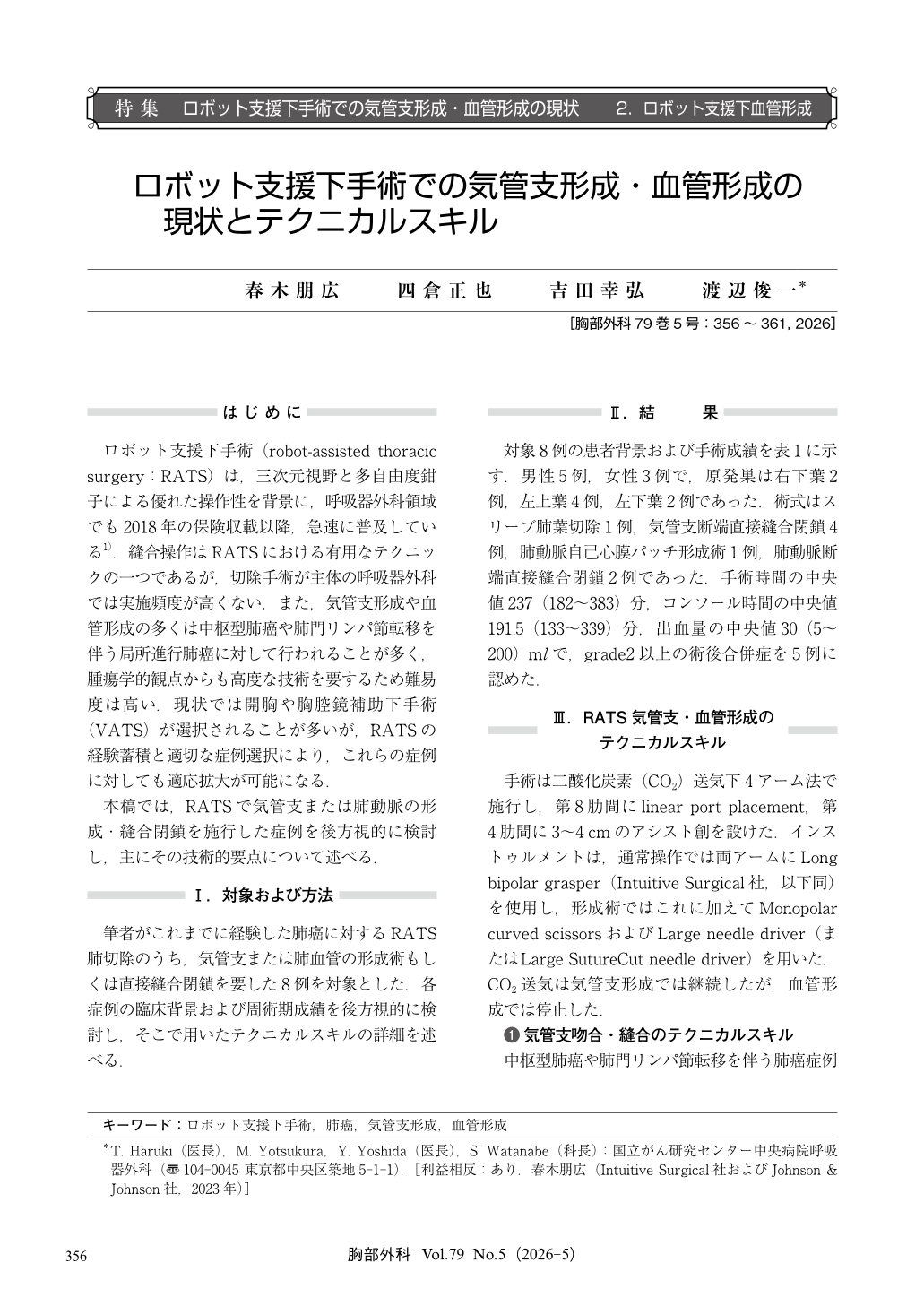
ロボット支援下手術(robot-assisted thoracic surgery:RATS)は,三次元視野と多自由度鉗子による優れた操作性を背景に,呼吸器外科領域でも2018年の保険収載以降,急速に普及している1).縫合操作はRATSにおける有用なテクニックの一つであるが,切除手術が主体の呼吸器外科では実施頻度が高くない.また,気管支形成や血管形成の多くは中枢型肺癌や肺門リンパ節転移を伴う局所進行肺癌に対して行われることが多く,腫瘍学的観点からも高度な技術を要するため難易度は高い.現状では開胸や胸腔鏡補助下手術(VATS)が選択されることが多いが,RATSの経験蓄積と適切な症例選択により,これらの症例に対しても適応拡大が可能になる.
Robot-assisted thoracoscopic surgery (RATS) has reached approximately 10,000 cases annually in Japan and has been established as one of the minimally invasive approaches. In the coming years, as institutions accumulate more experience, the indications are expected to expand to more complex cases. Among these, suturing techniques required for bronchial and pulmonary vessel reconstruction are particularly valuable in RATS due to the multi-articulated instruments;however, their frequency remains limited since resection procedures constitute the mainstay of thoracic surgery. Moreover, the typical candidates are technically and oncologically challenging cases, such as central lung cancer and locally advanced lung cancer with hilar lymph node involvement. Therefore, it is essential to share and systematically accumulate technical refinements and insights based on experience, including the use of barbed sutures in bronchial anastomosis and clamp management during pulmonary artery reconstruction. Mastery and practice of these technical skills by a greater number of thoracic surgeons will form the foundation for ensuring the safety and further effective development of RATS in Japan.
© Nankodo Co., Ltd., 2026