Japanese
English
- 販売していません
- Abstract 文献概要
- 1ページ目 Look Inside
- 参考文献 Reference
はじめに
外眼筋麻痺による眼球運動障害は融像障害による複視を生じ,日常生活活動(activities of daily living:ADL)や生活の質(quality of life:QOL)の低下をきたす1-3).脳卒中などによる後天的な複視に対しては,経過観察を行いながら,眼球運動訓練を取り入れ,必要時には片眼遮蔽,プリズム眼鏡を検討していくことが多い4, 5).眼球運動訓練は一般的に,視機能検査や視能訓練を業務とする視能訓練士が眼科医の指示で行う.回復期リハビリテーション病棟の主要疾患である脳卒中や外傷性脳損傷は患者全体の37%に斜視を生じ,さらにそのうちの36%は複視も生じると報告されている6).しかしながら,眼科のある病院以外では視能訓練士に相談できる環境が整備された回復期リハビリテーション病棟はほとんどない.本邦において,理学療法士(physical therapist:PT),作業療法士(occupational therapist:OT),言語聴覚士(speech therapist:ST)などの療法士が視能訓練を行った報告は追視,固視,輻輳,saccade7)といった4種の眼球運動訓練8),迷路性眼球反射促通法9),健側遮断10),両眼注視訓練11)などが報告されている.多くの報告は眼科評価も可能な総合病院で行われており,眼科との連携が難しい単科の回復期リハビリテーション病棟での報告は健側遮断訓練のみであった10).
今回当院回復期リハビリテーション病棟で,従来の視能訓練実施後も遠方や側方視の際に複視が残存したくも膜下出血の症例を経験した.視能訓練士の対応不可能な回復期リハビリテーション病棟でも実施可能な評価と視能訓練を行った.また,融像側方移動訓練7, 12)を参考とし,従来の両眼注視訓練に注視対象の移動を加えた.その結果,残存した右方視の複視が改善し,自動車運転を再開できた症例を経験したため報告する.
なお,本報告に際して,症例報告を行うことを患者本人より文書で同意を得た上で当院倫理委員会からの承認を得た(番号:202401).
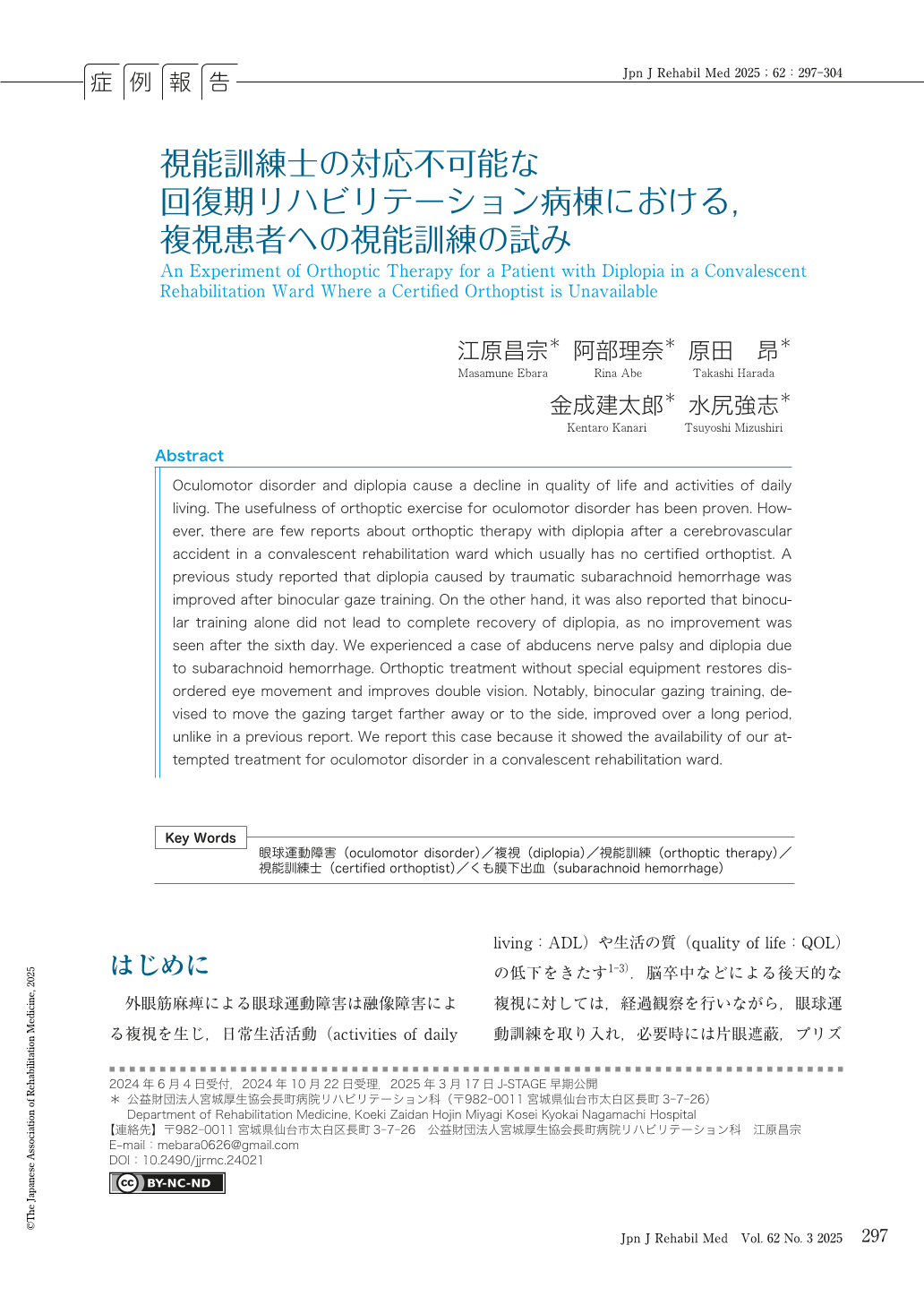
Abstract Oculomotor disorder and diplopia cause a decline in quality of life and activities of daily living. The usefulness of orthoptic exercise for oculomotor disorder has been proven. However, there are few reports about orthoptic therapy with diplopia after a cerebrovascular accident in a convalescent rehabilitation ward which usually has no certified orthoptist. A previous study reported that diplopia caused by traumatic subarachnoid hemorrhage was improved after binocular gaze training. On the other hand, it was also reported that binocular training alone did not lead to complete recovery of diplopia, as no improvement was seen after the sixth day. We experienced a case of abducens nerve palsy and diplopia due to subarachnoid hemorrhage. Orthoptic treatment without special equipment restores disordered eye movement and improves double vision. Notably, binocular gazing training, devised to move the gazing target farther away or to the side, improved over a long period, unlike in a previous report. We report this case because it showed the availability of our attempted treatment for oculomotor disorder in a convalescent rehabilitation ward.
Copyright © 2025, The Japanese Association of Rehabilitation Medicine. All rights reserved.