Japanese
English
- 有料閲覧
- Abstract 文献概要
- 1ページ目 Look Inside
- 参考文献 Reference
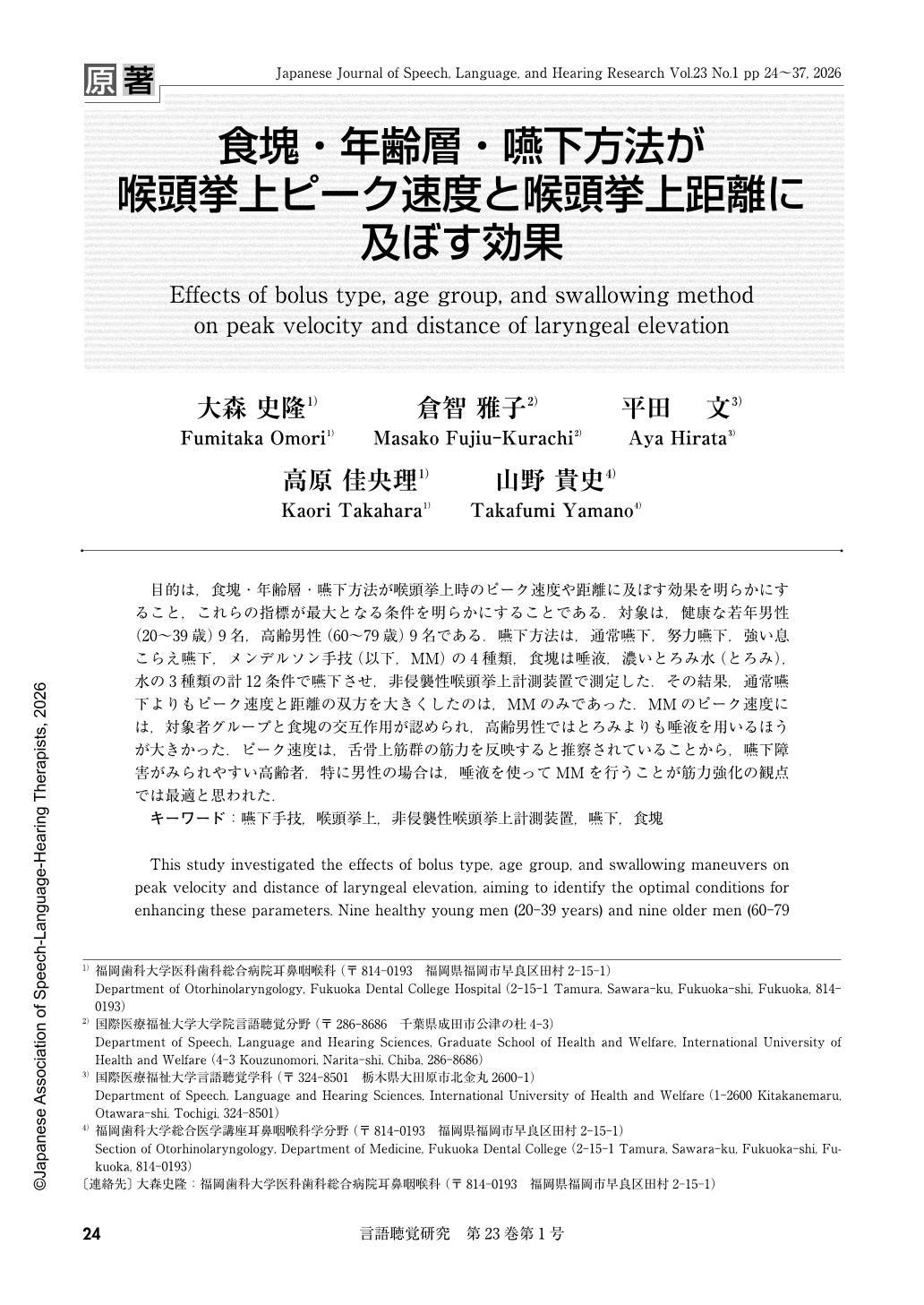
目的は,食塊・年齢層・嚥下方法が喉頭挙上時のピーク速度や距離に及ぼす効果を明らかにすること,これらの指標が最大となる条件を明らかにすることである.対象は,健康な若年男性(20〜39歳)9名,高齢男性(60〜79歳)9名である.嚥下方法は,通常嚥下,努力嚥下,強い息こらえ嚥下,メンデルソン手技(以下,MM)の4種類,食塊は唾液,濃いとろみ水(とろみ),水の3種類の計12条件で嚥下させ,非侵襲性喉頭挙上計測装置で測定した.その結果,通常嚥下よりもピーク速度と距離の双方を大きくしたのは,MMのみであった.MMのピーク速度には,対象者グループと食塊の交互作用が認められ,高齢男性ではとろみよりも唾液を用いるほうが大きかった.ピーク速度は,舌骨上筋群の筋力を反映すると推察されていることから,嚥下障害がみられやすい高齢者,特に男性の場合は,唾液を使ってMMを行うことが筋力強化の観点では最適と思われた.
This study investigated the effects of bolus type, age group, and swallowing maneuvers on peak velocity and distance of laryngeal elevation, aiming to identify the optimal conditions for enhancing these parameters. Nine healthy young men (20-39 years) and nine older men (60-79 years) performed four swallowing maneuvers (normal swallow, effortful swallow, super-supraglottic swallow, and the Mendelsohn maneuver) using three bolus types (saliva, thickened water, and water), for a total of 12 conditions. Laryngeal peak velocity and elevation distance were measured using a noninvasive device. Among the swallowing maneuvers, only the Mendelsohn maneuver increased both peak velocity and distance compared to normal swallowing. A significant interaction was observed between bolus type and participant group:in older men, peak velocity during the Mendelsohn maneuver was greater with saliva than with thickened water. Since peak velocity is considered to reflect the strength of suprahyoid muscles, performing the Mendelsohn maneuver with saliva may be optimal for muscle strengthening in older men, who are more susceptible to dysphagia.
Copyright © 2026, Japanese Association of Speech-Language-Hearing Therapists. All rights reserved.