Japanese
English
- 販売していません
- Abstract 文献概要
- 1ページ目 Look Inside
- 参考文献 Reference
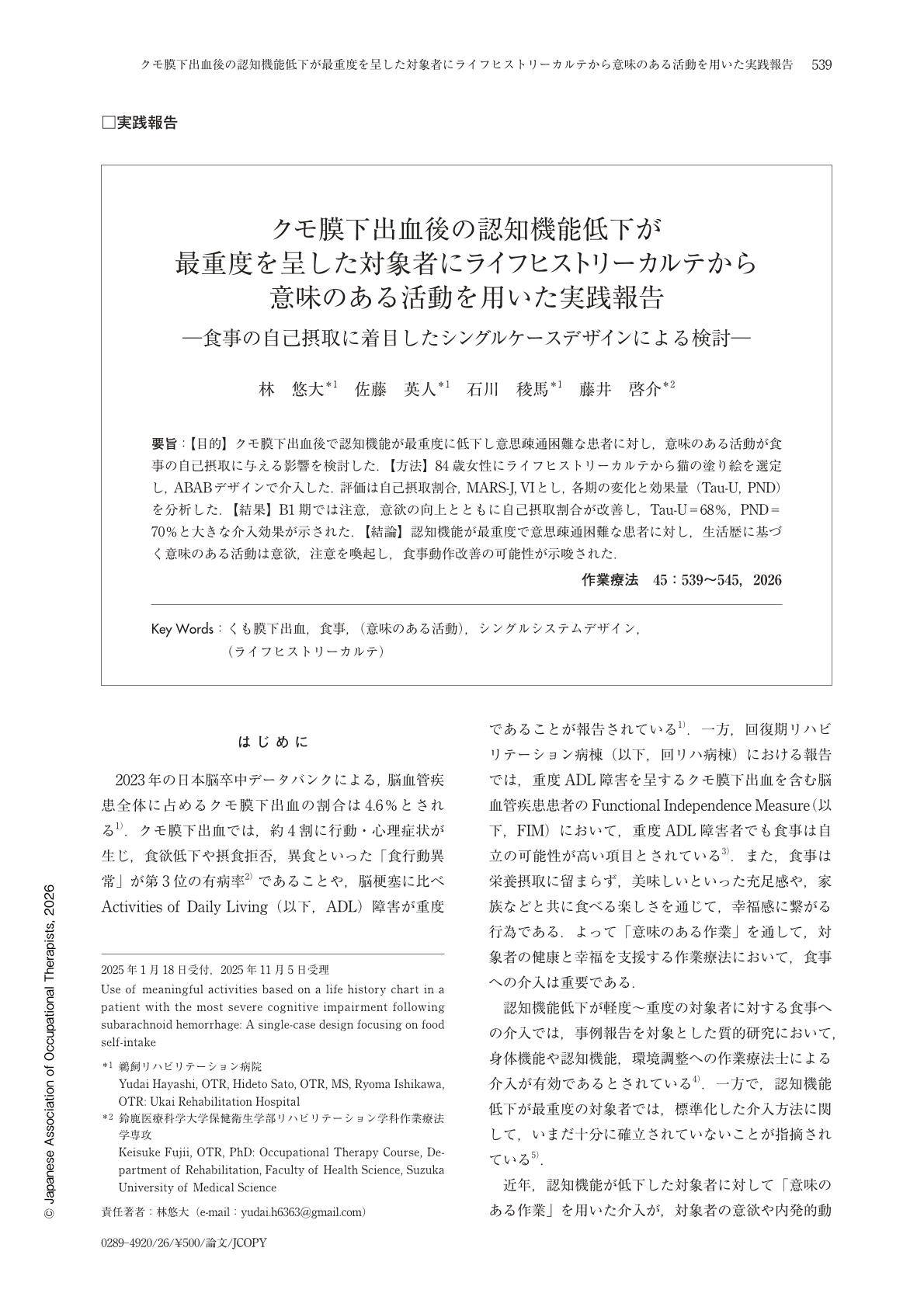
要旨:【目的】クモ膜下出血後で認知機能が最重度に低下し意思疎通困難な患者に対し,意味のある活動が食事の自己摂取に与える影響を検討した.【方法】84歳女性にライフヒストリーカルテから猫の塗り絵を選定し,ABABデザインで介入した.評価は自己摂取割合,MARS-J, VIとし,各期の変化と効果量(Tau-U,PND)を分析した.【結果】B1期では注意,意欲の向上とともに自己摂取割合が改善し,Tau-U=68%,PND=70%と大きな介入効果が示された.【結論】認知機能が最重度で意思疎通困難な患者に対し,生活歴に基づく意味のある活動は意欲,注意を喚起し,食事動作改善の可能性が示唆された.
Objective: This study aimed to examine the effects of a meaningful activity-based intervention on self-feeding in a patient with severe cognitive decline and impaired communication following subarachnoid hemorrhage. Methods: An 84-year-old woman participated in an ABAB single-case design study. A cat-themed coloring activity which was selected based on her life history chart was implemented during the B phases. Outcome measures included the percentage of self-feeding, the Motivation Assessment for Residents in Japan (MARS-J), and the Vitality Index. Phase-wise changes and effect sizes were analyzed using Tau-U and the percentage of non-overlapping data (PND). Results: During phase B1, improvements in attention and motivation were accompanied by an increased percentage of self-feeding. The intervention demonstrated a large effect size (Tau-U=68%, PND=70%). Conclusion: Meaningful activities grounded in an individual's life history may enhance attention and motivation, thereby improving self-feeding performance.
Copyright © 2026, Japanese Association of Occupational Therapists. All rights reserved.