Japanese
English
- 有料閲覧
PPV購入案内
1,320円 (1,200円+税10%) こちらは、642ページから653ページの文献です。購入には医書.jp本会員登録が必要です。
会員登録完了後に改めて上記「購入サイトへ」を選択してください。
または「購入サイトへ」選択後に「購入ログイン」、「新規会員登録」の順に進んでください。
会員登録について詳しくはをご確認ください。
- Abstract 文献概要
- 1ページ目 Look Inside
- 参考文献 Reference
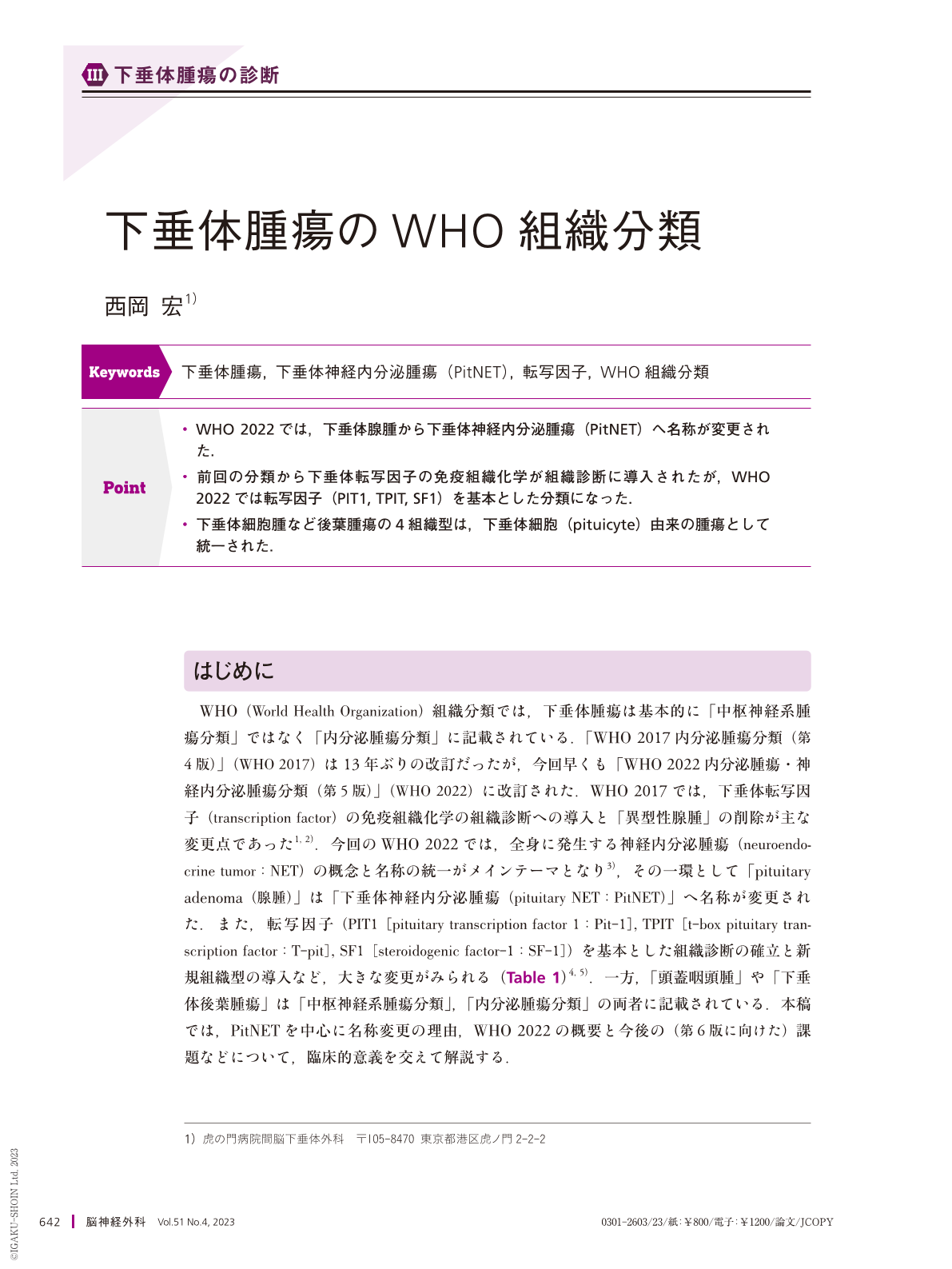
Point
・WHO 2022では,下垂体腺腫から下垂体神経内分泌腫瘍(PitNET)へ名称が変更された.
・前回の分類から下垂体転写因子の免疫組織化学が組織診断に導入されたが,WHO 2022では転写因子(PIT1, TPIT, SF1)を基本とした分類になった.
・下垂体細胞腫など後葉腫瘍の4組織型は,下垂体細胞(pituicyte)由来の腫瘍として統一された.
The major changes in the upcoming 5th edition of the “2022 WHO Classification of Endocrine and Neuroendocrine Tumors” include:(1)evolution of the nomenclature: from pituitary adenoma to pituitary neuroendocrine tumour(PitNET),(2)detailed subtyping of a PitNET based on the tumor lineage, cell type, and related characteristics,(3)endorsement of the routine use of immunohistochemistry for pituitary transcription factors(PIT1, TPIT, SF1, GATA3, and ER-alpha),(4)introduction of some additional clinicopathologically distinct PitNET subtypes,(5)introduction of the term “metastatic PitNET” to replace the previous terminology “pituitary carcinoma,” and(6)unifying posterior lobe tumors, the family of pituicyte tumors that invariably express TTF1, et al.
Currently, no widely agreed grading or staging systems for PitNETs exist. Prognosis varies by tumor subtype and certain tumor subtypes are recognized as more aggressive(high-risk PitNETs)than others. Potentially aggressive PitNETs should be identified on an individual basis upon considering the tumor subtype, proliferative potential, and tumor invasion assessment.
Copyright © 2023, Igaku-Shoin Ltd. All rights reserved.