Japanese
English
- 有料閲覧
PPV購入案内
1,320円 (1,200円+税10%) こちらは、687ページから694ページの文献です。購入には医書.jp本会員登録が必要です。
会員登録完了後に改めて上記「購入サイトへ」を選択してください。
または「購入サイトへ」選択後に「購入ログイン」、「新規会員登録」の順に進んでください。
会員登録について詳しくはをご確認ください。
- Abstract 文献概要
- 1ページ目 Look Inside
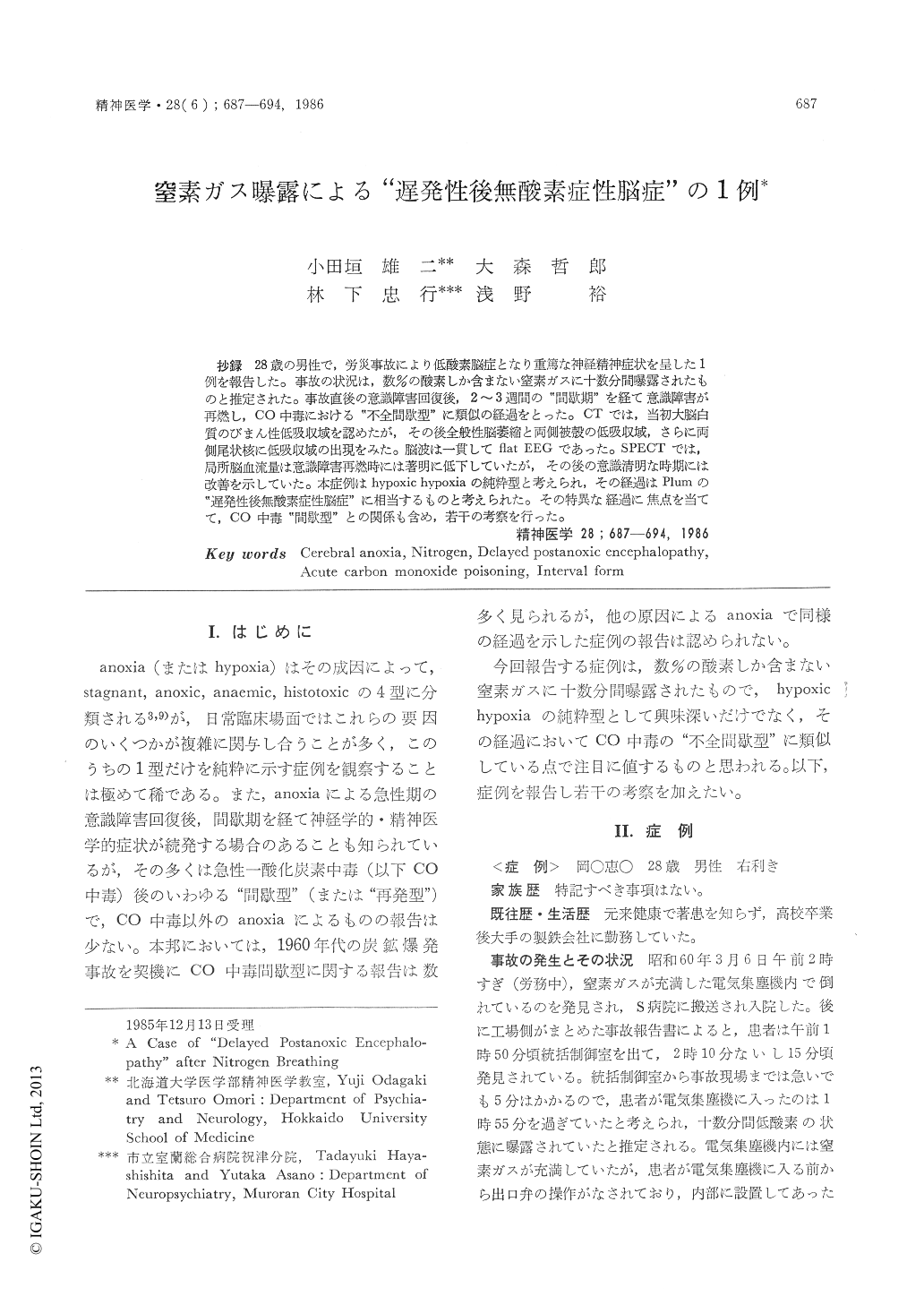
抄録 28歳の男性で,労災事故により低酸素脳症となり重篤な神経精神症状を呈した1例を報告した。事故の状況は,数%の酸素しか含まない窒素ガスに十数分間曝露されたものと推定された。事故直後の意識障害回復後,2〜3週間の“間歇期”を経て意識障害が再燃し,CO中毒における“不全間歇型”に類似の経過をとった。CTでは,当初大脳白質のびまん性低吸収域を認めたが,その後全般性脳萎縮と両側被殻の低吸収域,さらに両側尾状核に低吸収域の出現をみた。脳波は一貫してflat EEGであった。SPECTでは,局所脳血流量は意識障害再燃時には著明に低下していたが,その後の意識清明な時期には改善を示していた。本症例はhypoxic hypoxiaの純粋型と考えられ,その経過はPlumの“遅発性後無酸素症性脳症”に相当するものと考えられた。その特異な経過に焦点を当てて,CO中毒“間歇型”との関係も含め,若干の考察を行った。
A 28-year-old steelworker entered a large factory room containing almost pure nitrogen mixed with less than 10% of oxgen, on Mar. 6, 1985. He lost consciousness and was rescued 10-20 minutes later. He was deeply comatose and unresponsive for a few hours, and then gradually became alert. Though severely apractic and agnostic, he appeared entirely well till about a month after the anoxic accident, when he became confused and unresponsive again, and sometimes delirious in the night. He was treated with Oxygen under High Pressure (OHP) and regained alertness approximately a month later.
CT scan on Mar. 11 revealed diffuse subcortical decreased density signifying brain edema, but on Apr. 13 there appeared diffuse cerebral atrophy with decreased density of bilateral putaminal regions. In addition, on April 18 there occurred decreased density in the heads and part of the bodies of bilatreal nuclei. Repeated electroencephalographic examination showed unchanged flat EEGs. Singlephoton emission computed tomography using Xe-133 inhalation method revealed that the mean regional cerebral blood flow was related to the patient's consciousness level. Thus, it was markedly decreased on Apr. 23 when he was suffering from relapsing consciousness disturbance, but was increased near to normal range on Jun. 12 when he was alert again. The NMR-CT finding was identical with the CT finding on Apr. 18, except for the indefinite finding that low density areas were scattered in the white matter.
The anoxic accident was investigated and it was confirmed that the patient suffered from pure hypoxic hypoxia which was not influenced by stagnant, anaemic, or histotoxic factors. The peculiar clinical course appeared to be similar to incomplete "interval form" after acute carbon monoxide (CO) intoxication and was considered to be consistent with "delayed postanoxic encephalopathy" described by Plum. It is necessary infuture to accumulate such cases as this one with anoxic encephalopathy not due to CO intoxication, in order to investigate the pathogenesis of "delayed postanoxic encephalopathy".
Copyright © 1986, Igaku-Shoin Ltd. All rights reserved.