Japanese
English
- 販売していません
PPV購入案内
都合により販売していません- Abstract 文献概要
- 1ページ目 Look Inside
- 参考文献 Reference
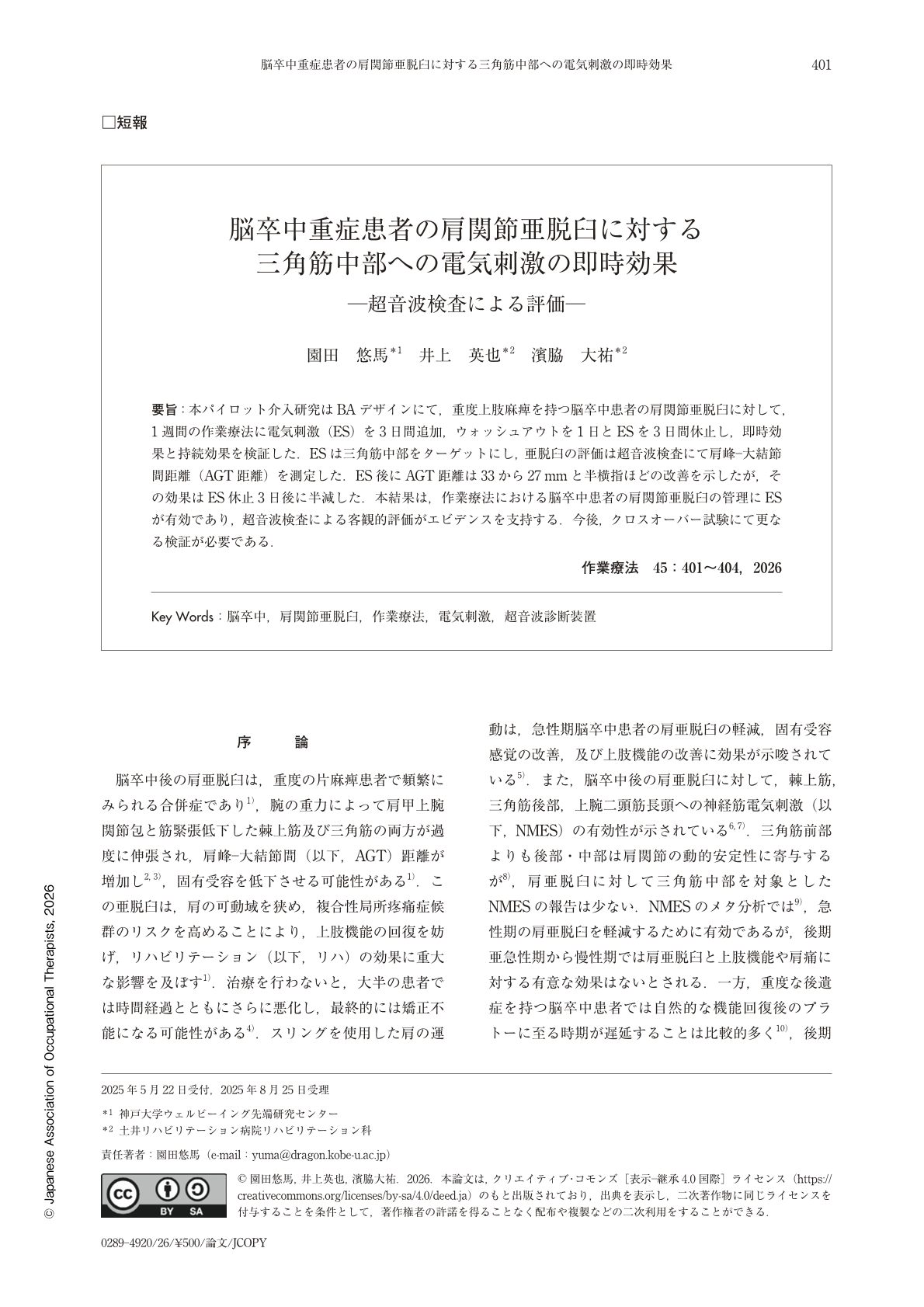
要旨:本パイロット介入研究はBAデザインにて,重度上肢麻痺を持つ脳卒中患者の肩関節亜脱臼に対して,1週間の作業療法に電気刺激(ES)を3日間追加,ウォッシュアウトを1日とESを3日間休止し,即時効果と持続効果を検証した.ESは三角筋中部をターゲットにし,亜脱臼の評価は超音波検査にて肩峰-大結節間距離(AGT距離)を測定した.ES後にAGT距離は33から27mmと半横指ほどの改善を示したが,その効果はES休止3日後に半減した.本結果は,作業療法における脳卒中患者の肩関節亜脱臼の管理にESが有効であり,超音波検査による客観的評価がエビデンスを支持する.今後,クロスオーバー試験にて更なる検証が必要である.
This pilot intervention study used a B-A design to treat shoulder subluxation in patients with severe upper limb paralysis following stroke. We examined the immediate and sustained effects of adding electrical stimulation for 3 days during 1 week of occupational therapy, followed by a 1-day washout period and 3 days free of electrical stimulation. The electrical stimulation targeted the middle deltoid muscle, and shoulder subluxation was assessed based on the acromion-greater tuberosity (AGT) distance, using ultrasonography. The median AGT distance decreased from 33 to 27 mm (approximately half the finger width) following the electrical stimulation, but this effect was halved 3 days after the stimulation was stopped. These results suggest that electrical stimulation during occupational therapy is effective for managing shoulder subluxation in patients recovering from stroke, as evidenced through objective ultrasonographic evaluation. Future crossover studies are warranted to validate these preliminary results.
Copyright © 2026, Japanese Association of Occupational Therapists. All rights reserved.