Japanese
English
- 有料閲覧
- Abstract 文献概要
- 1ページ目 Look Inside
- 参考文献 Reference
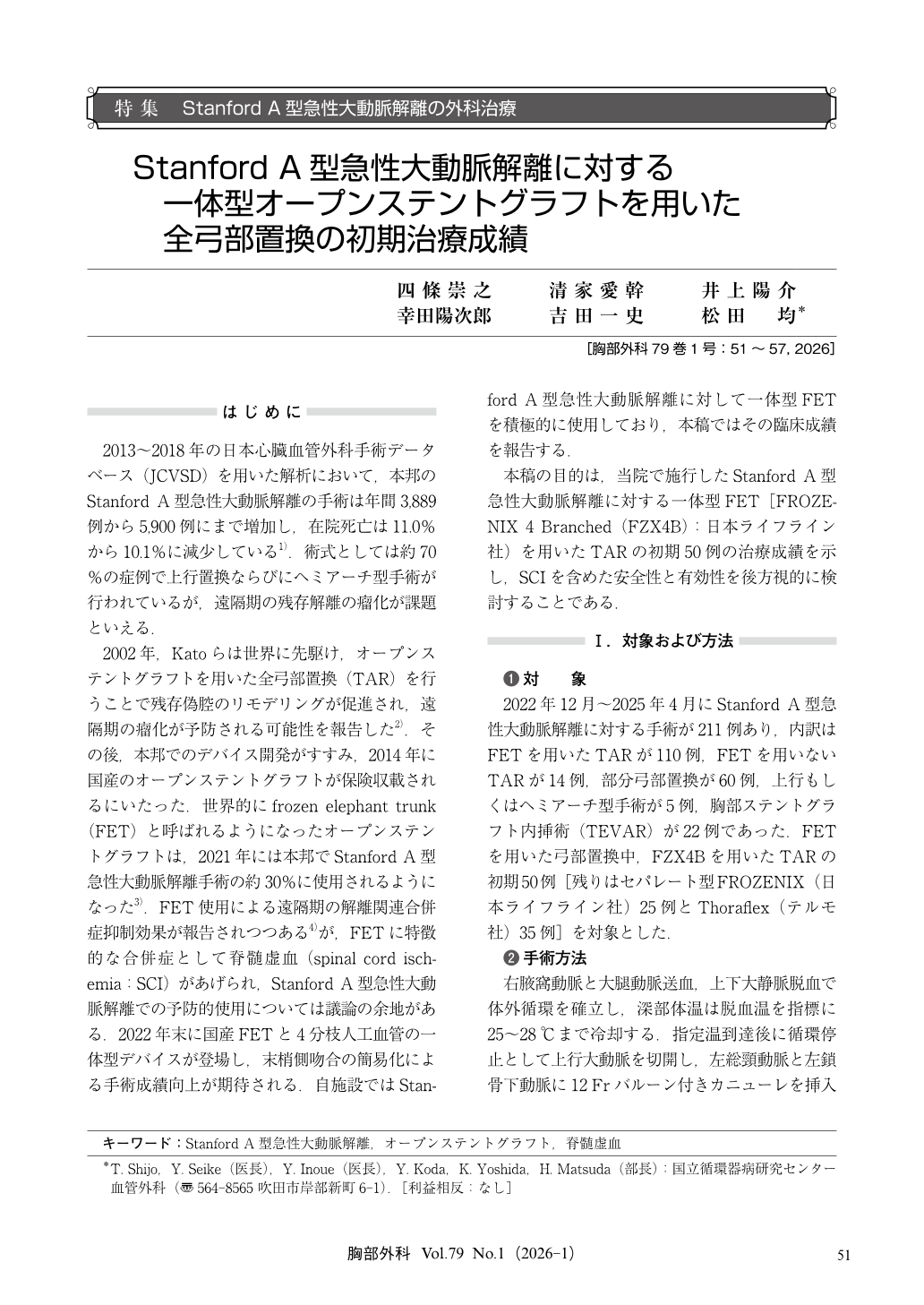
2013~2018年の日本心臓血管外科手術データベース(JCVSD)を用いた解析において,本邦のStanford A型急性大動脈解離の手術は年間3,889例から5,900例にまで増加し,在院死亡は11.0%から10.1%に減少している1).術式としては約70%の症例で上行置換ならびにヘミアーチ型手術が行われているが,遠隔期の残存解離の瘤化が課題といえる.
Objectives:In Japan, surgical repair for Stanford type A acute aortic dissection (AAAD) has been increasingly performed, accompanied by gradual improvement in early outcomes. While ascending or hemiarch replacement remains the mainstream strategy, late aneurysmal dilatation of the residual dissected aorta is still a concern. The frozen elephant trunk (FET) technique, which facilitates aortic remodeling, has been increasingly adopted in AAAD surgery. Since the introduction of a domestic integrated four-branched FET device in late 2022, expectations have risen for improved procedural safety and simplicity. We report our early institutional outcomes of total arch replacement (TAR) using the integrated four-branched FET.
Methods:Among 211 AAAD cases treated between December 2022 and April 2025, 110 underwent TAR with FET, of which the first 50 consecutive cases using the integrated four-branched FET [FROZENIX 4 Branched (FZX4B)] were retrospectively analyzed. The primary endpoint was early postoperative outcome, including mortality and spinal cord ischemia (SCI). Secondary endpoints included mid-term survival, freedom from aortic events, and morphologic changes in the descending aorta.
Results:The median age was 65 years [interquartile range (IQR):56~74], and 29 patients (58%) were male. The median operative time was 372 minutes (IQR:315~506), and the hypothermic circulatory arrest time was 42 minutes (IQR:38~50). The distal anastomosis was performed in zone 3 in 84% of cases. The FZX4B diameter most used was 25 mm (60%). In-hospital mortality was 4%. SCI occurred in one patient (2%). Two patients (4%) required additional thoracic endovascular aortic repair (TEVAR) for FET stenosis. The median follow-up was 248 days (IQR:165~472). Overall survival was 93% at 1 year and 86% at 2 years, and freedom from aortic events was 87% and 81% at 1 and 2 years, respectively. The FET distal level was mainly at Th6 (62%). The aortic diameter at the distal edge of the FET decreased from 30 mm (IQR:28~33) preoperatively to 27 mm (25~31) at 1 year (p<0.001). The FET tip diameter correlated with the preoperative outer diameter at the anastomotic site (r=0.66, p<0.001).
Conclusions:Although FET-related stenosis should be recognized as a potential procedural risk, TAR using the integrated FET for AAAD achieved acceptable early outcomes. A larger comparative study with conventional repair is warranted to elucidate its statistical impact.
© Nankodo Co., Ltd., 2026