Japanese
English
- 販売していません
- Abstract 文献概要
- 1ページ目 Look Inside
- 参考文献 Reference
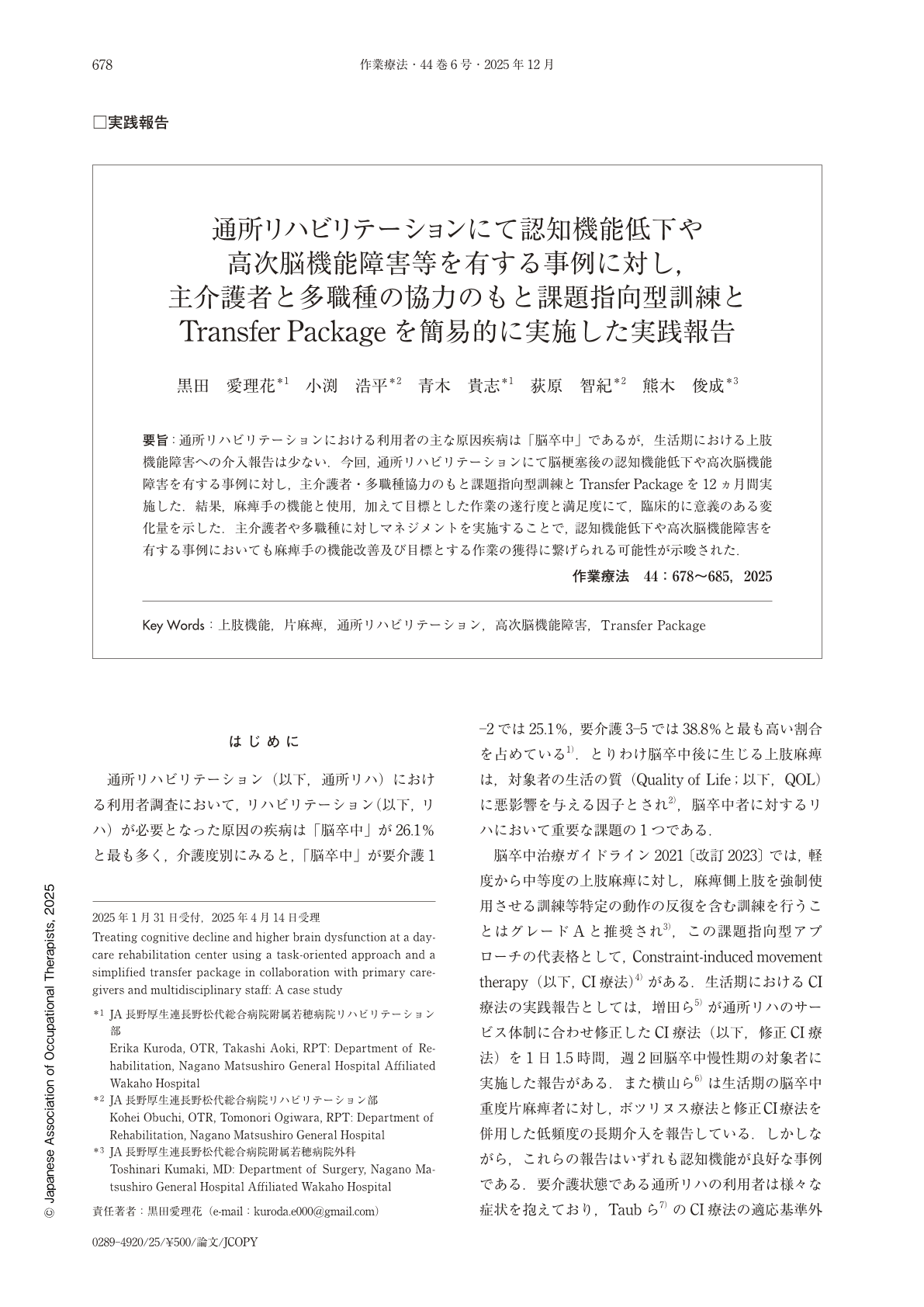
要旨:通所リハビリテーションにおける利用者の主な原因疾病は「脳卒中」であるが,生活期における上肢機能障害への介入報告は少ない.今回,通所リハビリテーションにて脳梗塞後の認知機能低下や高次脳機能障害を有する事例に対し,主介護者・多職種協力のもと課題指向型訓練とTransfer Packageを12ヵ月間実施した.結果,麻痺手の機能と使用,加えて目標とした作業の遂行度と満足度にて,臨床的に意義のある変化量を示した.主介護者や多職種に対しマネジメントを実施することで,認知機能低下や高次脳機能障害を有する事例においても麻痺手の機能改善及び目標とする作業の獲得に繋げられる可能性が示唆された.
Although ‘stroke’ is the most common condition among users of day rehabilitation (hereafter referred to as ‘day rehabilitation’), there are few reports of interventions for upper limb dysfunction in the lifetime phase. In this study, a case with cognitive decline and higher brain dysfunction after stroke was treated in a day-care center, and task-oriented training and a transfer package were delivered over 12 months in collaboration with the primary caregiver and multidisciplinary staff, with reference to previous studies. The results showed clinically significant changes in the function and use of the paralyzed hand, as well as in the performance and satisfaction of targeted tasks, indicating that management by the primary caregiver and other professionals could lead to functional improvement of the paralyzed hand and acquisition of target tasks, even in cases of cognitive decline and higher brain dysfunction.
Copyright © 2025, Japanese Association of Occupational Therapists. All rights reserved.