Japanese
English
- 有料閲覧
PPV購入案内
1,320円 (1,200円+税10%) こちらは、343ページから355ページの文献です。購入には医書.jp本会員登録が必要です。
会員登録完了後に改めて上記「購入サイトへ」を選択してください。
または「購入サイトへ」選択後に「購入ログイン」、「新規会員登録」の順に進んでください。
会員登録について詳しくはをご確認ください。
- Abstract 文献概要
- 1ページ目 Look Inside
- 参考文献 Reference
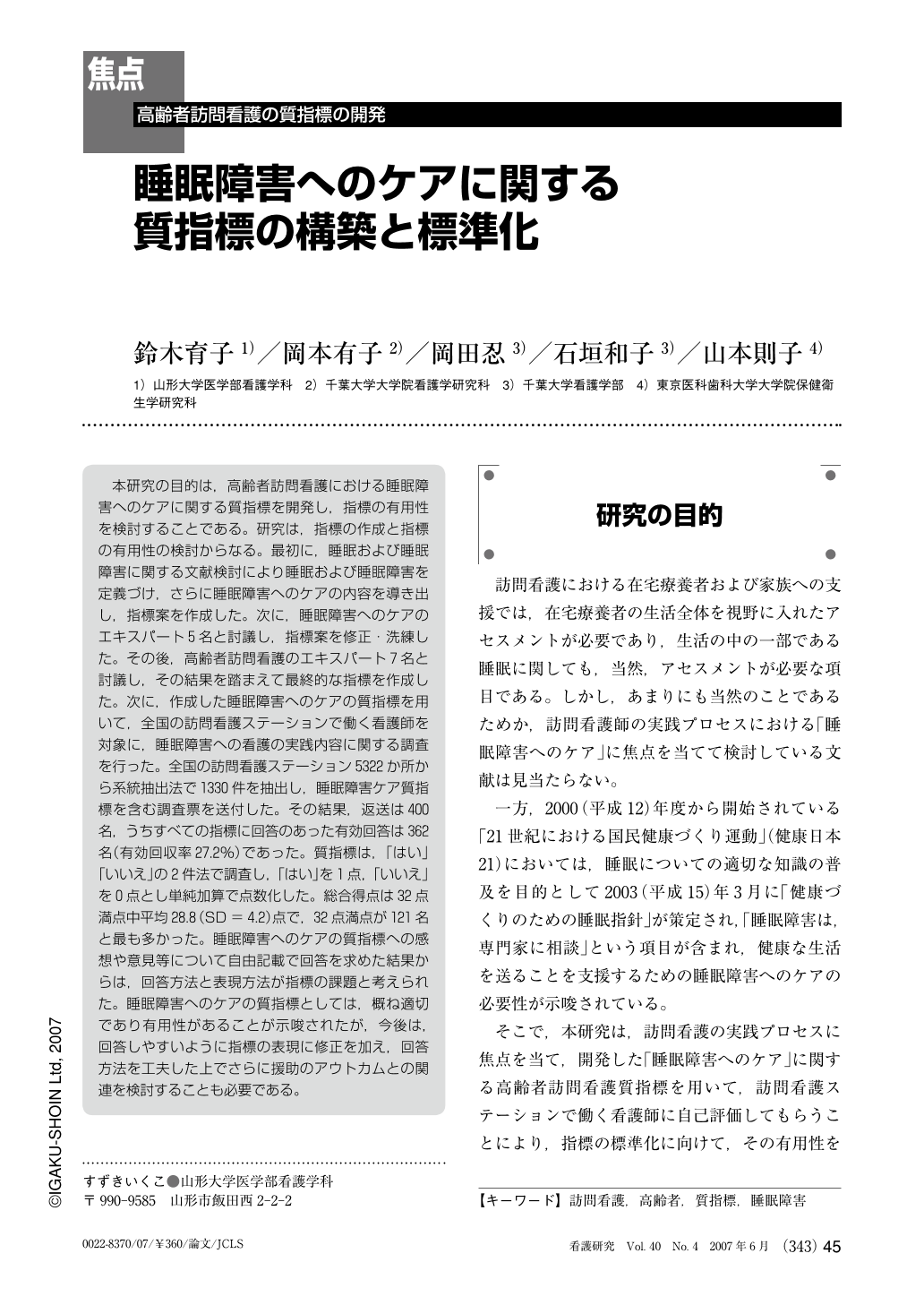
本研究の目的は,高齢者訪問看護における睡眠障害へのケアに関する質指標を開発し,指標の有用性を検討することである。研究は,指標の作成と指標の有用性の検討からなる。最初に,睡眠および睡眠障害に関する文献検討により睡眠および睡眠障害を定義づけ,さらに睡眠障害へのケアの内容を導き出し,指標案を作成した。次に,睡眠障害へのケアのエキスパート5名と討議し,指標案を修正・洗練した。その後,高齢者訪問看護のエキスパート7名と討議し,その結果を踏まえて最終的な指標を作成した。次に,作成した睡眠障害へのケアの質指標を用いて,全国の訪問看護ステーションで働く看護師を対象に,睡眠障害への看護の実践内容に関する調査を行った。全国の訪問看護ステーション5322か所から系統抽出法で1330件を抽出し,睡眠障害ケア質指標を含む調査票を送付した。その結果,返送は400名,うちすべての指標に回答のあった有効回答は362名(有効回収率27.2%)であった。質指標は,「はい」「いいえ」の2件法で調査し,「はい」を1点,「いいえ」を0点とし単純加算で点数化した。総合得点は32点満点中平均28.8(SD=4.2)点で,32点満点が121名と最も多かった。睡眠障害へのケアの質指標への感想や意見等について自由記載で回答を求めた結果からは,回答方法と表現方法が指標の課題と考えられた。睡眠障害へのケアの質指標としては,概ね適切であり有用性があることが示唆されたが,今後は,回答しやすいように指標の表現に修正を加え,回答方法を工夫した上でさらに援助のアウトカムとの関連を検討することも必要である。
The purpose of this study was to develop quality indicators (QIs) for sleep care in home nursing for aged and to examine their applicability. First, based upon the literature review, we defined sleep and sleep disturbance, derived an essential sleep care process from the literature, and developed the QI pool. Next we discussed the QIs with 5 experts on sleep care and improved the contents. We further discussed the QIs with 7 experts in home nursing for aged in order to finalize them. We then conducted a nationwide questionnaire survey on the clinical practice, including sleep care, of home nurses for aged. Thirteen-thousand and thirty (1330) nursing stations were systematically sampled out of the total of 5322 stations in Japan. The home nurses working in those stations received the questionnaire that included QIs for sleep care. A total of 400 nurses responded, in which 362 completed all the questions regarding sleep care (response rate 27.2%). Indicators were answered yes (=1) if the nurse generally practiced the contents of the indicator, while no (=0) meant that the nurse did not usually practice the contents. The total score was derived by summing all the answers concerned with sleep care. The average of the total scores was 28.8 (SD=4.2) out of the perfect score of 32. One-hundred and twenty-two (122) nurses scored perfect, and they are the largest group. Some free comments regarding the QIs indicated that certain changes were needed on response options and wordings of some indicators. The results show that the QIs are generally appropriate and have utility in clinical home nursing. However, we still need to work on some wordings and answer options. In future studies the association between the score in QIs and client outcomes should be examined.
Copyright © 2007, Igaku-Shoin Ltd. All rights reserved.